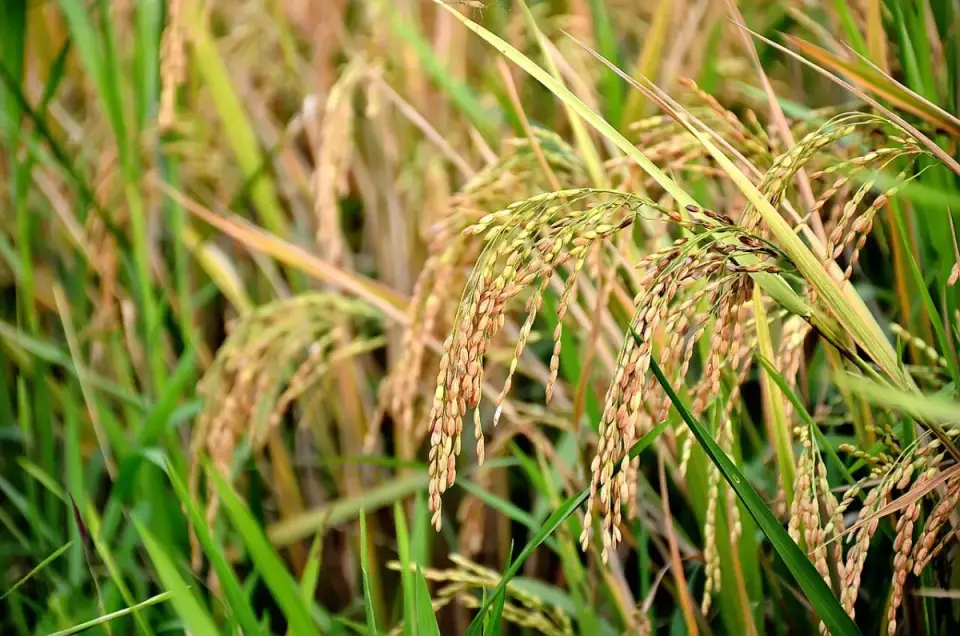
Rice (Oryza sativa)
Photo: Augustus Binu : flickr : Instagram, CC BY-SA 3.0, Wikimedia Commons

On the map in 17 countries crop

Rice

Oryza sativa

Family: Poaceae

On our map this plant appears in 17 countries and ranks highest in: Laos, Thailand, Suriname, Guinea-Bissau, Bangladesh, Indonesia and others.

An annual grass growing 0.6–1.5 m tall, with hollow stems, long, narrow leaves and drooping panicles in which the husked grains ripen. Most varieties are grown in flooded paddies, where a layer of water protects the plants from weeds, although there are also upland varieties grown on dry ground. There are two main groups – short-grained japonica rice, which turns sticky when cooked, and long-grained indica. The grain is eaten boiled, made into noodles, flour and cakes, and fermented into rice wine and vinegar.

Description from: China.

More: Wikipedia (en) Wikipedia (pl) Plants of the World Online (Kew)

Significance in each country

  1. Laos no. 2 of 5 introduced or naturalised

    Sticky rice is the foundation of Lao identity – the Lao jokingly call themselves “children of sticky rice”, and their annual per capita consumption is the highest in the world. It is served in tip khao bamboo baskets with every meal.

  2. Thailand no. 2 of 10 introduced or naturalised

    For decades Thailand has been one of the world’s two or three largest rice exporters, and rice paddies are the country’s most typical landscape. The annual Royal Ploughing Ceremony in Bangkok symbolically opens the planting season.

  3. Suriname no. 4 of 5 cultivated

    Rice growing in Suriname was developed by contract labourers who arrived from India and Java in the 19th and 20th centuries; today rice is one of the country’s main agricultural and export products, and the Nickerie district is its centre.

  4. Guinea-Bissau no. 5 of 5 cultivated

    For centuries the Balanta and other coastal peoples have turned mangroves into rice paddies – bolanhas – surrounded by dykes, which rainwater gradually leaches of salt.

  5. Bangladesh no. 6 of 10 cultivated

    Bangladesh is one of the world’s largest rice producers; rice covers most of the country’s arable land and is grown in three seasons: aus, aman and boro.

  6. Indonesia no. 6 of 15 cultivated

    Indonesia is one of the world’s leading producers and consumers of rice, and nasi – cooked rice – is the basis of almost every meal.

  7. Iraq no. 6 of 8 cultivated

    Rice accompanies almost every Iraqi lunch, and long-grain anbar, whose scent recalls ambergris (anbar in Arabic), is considered the finest.

  8. Myanmar no. 6 of 10 cultivated

    Rice is the foundation of Burmese cuisine – the common greeting “htamin sa pi bi la?” means “have you eaten rice yet?”.

  9. Philippines no. 6 of 10 cultivated

    The rice terraces of the Ifugao people, carved into the slopes of the Cordillera Central, were inscribed on the UNESCO World Heritage List in 1995.

  10. Senegal no. 6 of 8 cultivated

    Ceebu jën – rice cooked in an aromatic tomato sauce with fish and vegetables – is the emblem of Senegalese cuisine and in 2021 was inscribed on UNESCO’s list of the intangible cultural heritage of humanity.

  11. Vietnam no. 6 of 10 cultivated

    Rice growing has shaped the Vietnamese countryside, calendar and cuisine – rice is made into noodles for phở and bún, rice paper and rượu rice liquor, while glutinous rice goes into bánh chưng, cakes wrapped in leaves for Tết.

  12. Madagascar no. 7 of 10 cultivated

    The Malagasy are among the world’s biggest rice eaters – the average person consumes more than 100 kg a year, usually with accompaniments called laoka.

  13. Nepal no. 7 of 10 cultivated

    Rice is Nepal’s most important crop and the basis of the daily meal of dal bhat.

  14. Sri Lanka no. 7 of 10 cultivated

    Rice (bath) is the foundation of Sri Lankan cooking, and for more than two thousand years its cultivation has relied on a network of “wewa” reservoirs and canals built by ancient kings.

  15. Pakistan no. 8 of 10 cultivated

    Pakistan is one of the world’s largest rice exporters, and basmati from Punjab is its most prized type and the subject of a long-running dispute with India over the right to the name.

  16. Japan no. 9 of 10 cultivated

    Rice growing reached Japan in the Yayoi period and has shaped its landscape, festival calendar and religion ever since – rice is offered to the Shinto gods, and the Niiname-sai harvest thanksgiving is performed by the emperor himself.

  17. China no. 11 of 15 native

    The Yangtze valley is one of the oldest centres of rice domestication, and China remains the world’s largest producer and consumer of rice; in Chinese the word fàn means both cooked rice and a meal in general.