China · #11 crop
Rice
Oryza sativa · locally: shuǐdào (水稻)
Rice has been grown in China for about 9,000 years – the Yuanyang and Longji terraces are among the world’s most beautiful farming landscapes.
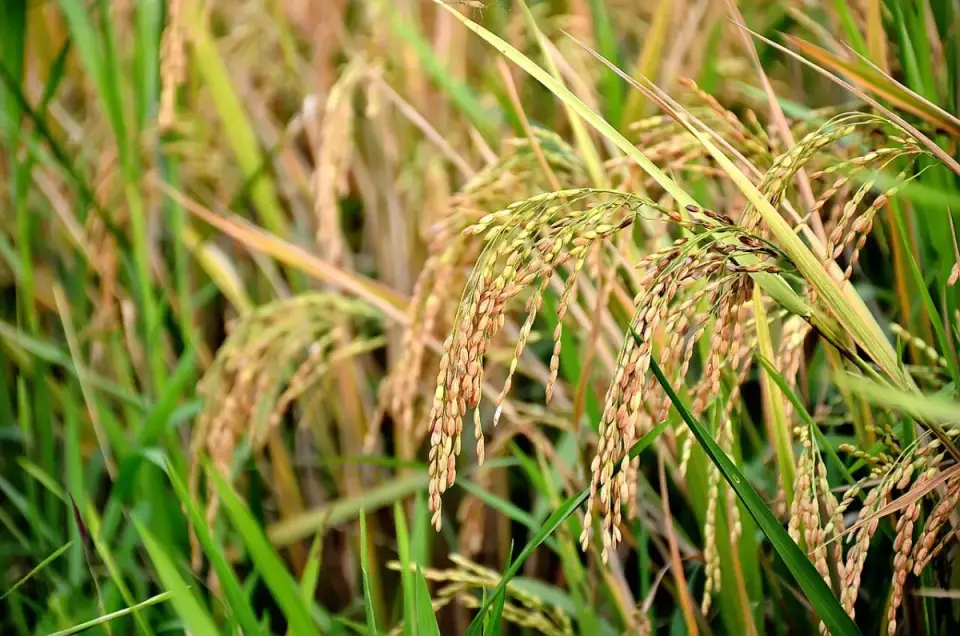
An annual grass growing 0.6–1.5 m tall, with hollow stems, long, narrow leaves and drooping panicles in which the husked grains ripen. Most varieties are grown in flooded paddies, where a layer of water protects the plants from weeds, although there are also upland varieties grown on dry ground. There are two main groups – short-grained japonica rice, which turns sticky when cooked, and long-grained indica. The grain is eaten boiled, made into noodles, flour and cakes, and fermented into rice wine and vinegar.
Significance in the country
The Yangtze valley is one of the oldest centres of rice domestication, and China remains the world’s largest producer and consumer of rice; in Chinese the word fàn means both cooked rice and a meal in general. The breeder Yuan Longping, creator of high-yielding hybrid rice, is a national hero in China.
Where it grows
The main growing areas are in the Yangtze basin (Hunan, Jiangxi, Hubei, Anhui, Jiangsu, Sichuan) and in the south of the country (Guangdong, Guangxi); in the north-east, especially Heilongjiang, prized short-grain rice is grown. Famous rice terraces are in Yunnan (Yuanyang) and Guangxi (Longji).
More: Wikipedia (en) Wikipedia (pl)