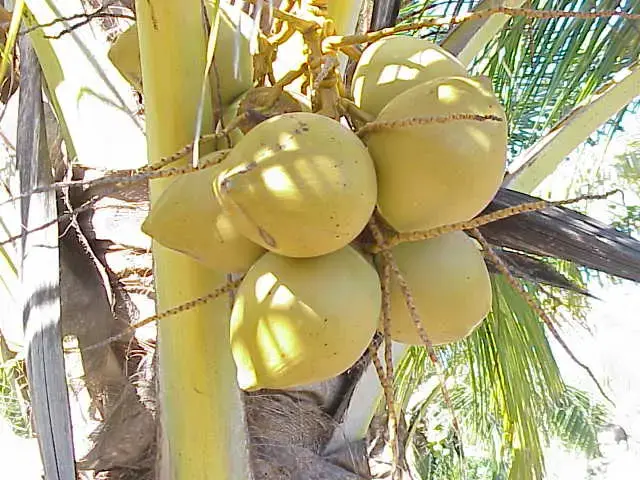
Coconut palm (Cocos nucifera)
Photo: Kurt Stüber [1], CC BY-SA 3.0, Wikimedia Commons

On the map in 15 countries palm symbol: India, Maldives, Samoa

Coconut palm

Cocos nucifera

Family: Arecaceae

On our map this plant appears in 15 countries and ranks highest in: Kiribati, Maldives, Marshall Islands, Mozambique, Nauru, Samoa and others.

The coconut palm has a slender trunk up to 30 m long and a crown of pinnate leaves, and its fruits ripen all year round. The most important ingredient in Samoan cooking is the thick coconut cream squeezed from the grated flesh, which is poured over food baked in the umu earth oven. The husk fibres are twisted into strong ’afa cord, used to lash together the frames of fale houses without nails, and the leaves are woven into baskets and blinds. Dried flesh, known as copra, and coconut oil have been among the country’s main exports since colonial times.

Description from: Samoa.

More: Wikipedia (en) Wikipedia (pl) Plants of the World Online (Kew)

Significance in each country

  1. Kiribati no. 1 of 5 cultivated

    Copra – dried coconut flesh – is, alongside fishing licences, Kiribati’s main source of income, and for people on the remote atolls it is often their only source of cash.

  2. Maldives no. 1 of 5 introduced or naturalised

    National tree of the Maldives, featured on the national emblem

    The coconut palm is the national tree of the Maldives and appears on the state emblem; its wood was used to build traditional dhoni boats, coconut fibre was twisted into rope, and grated coconut is the basis of the breakfast dish mas huni…

  3. Marshall Islands no. 1 of 5 introduced or naturalised

    For years the government of the Marshall Islands has bought copra at a fixed, subsidised price to provide an income for people on remote atolls.

  4. Mozambique no. 1 of 8 cultivated

    Inhambane Province is famous for its endless coconut groves, and the plantations around Quelimane in Zambezia were once among the largest in the world.

  5. Nauru no. 2 of 5 introduced or naturalised

    On Nauru, where most food is now imported, coconut palms are a reminder of the traditional, self-sufficient way of life before the phosphate era.

  6. Samoa no. 2 of 5 native

    Coconut palm on the national emblem (state seal) of Samoa

    A coconut palm rising from the waves appears on the state seal of Samoa, symbolising how the islanders’ lives depend on this plant. Samoa’s national dish, palusami, consists of taro leaves wrapped around coconut cream and baked in the umu.

  7. Comoros no. 3 of 5 introduced or naturalised

    Coconut milk is the foundation of Comorian cooking – fish, rice and madaba, a traditional dish of cassava leaves, are cooked in it. Copra was once an important export, and coconut groves still shape the landscape of coastal villages.

  8. Philippines no. 5 of 10 native

    Filipinos call the coconut the “tree of life” (puno ng buhay): it provides coconut milk for cooking, vinegar, sugar, lambanog liquor, building material and oil.

  9. São Tomé & Príncipe no. 5 of 5 introduced or naturalised

    Coconut palms grow along almost the entire coastline of both islands; coconut milk is an important ingredient of fish dishes, and the water from young fruits is a popular drink.

  10. Solomon Islands no. 5 of 5 native

    At the beginning of the 20th century the British firm Lever Brothers established some of the largest coconut plantations in the Pacific in the Russell Islands and on Guadalcanal.

  11. Vanuatu no. 5 of 5 native

    In Vanuatu copra has been the backbone of the economy since the days of the colonial plantations of the Anglo-French condominium.

  12. Sri Lanka no. 6 of 10 cultivated

    Sri Lanka is one of the leading producers and exporters of coconuts, and a coconut palm grows in almost every home garden.

  13. Papua New Guinea no. 7 of 10 native

    Coconut plantations were established from the late 19th century, especially on New Britain, New Ireland and Bougainville, and for decades copra was the colony’s main export.

  14. India no. 11 of 15 introduced or naturalised

    State tree of Kerala

    India is one of the world’s largest coconut producers, and the coconut palm is the state tree of Kerala, whose name is often derived from the Malayalam word “kera” – coconut.

  15. Indonesia no. 11 of 15 native

    Indonesia is one of the world’s largest coconut producers. Coconut milk (santan) is the base of many Indonesian dishes, such as rendang and opor ayam, and young palm leaves are woven into ketupat pouches in which rice is cooked for the…