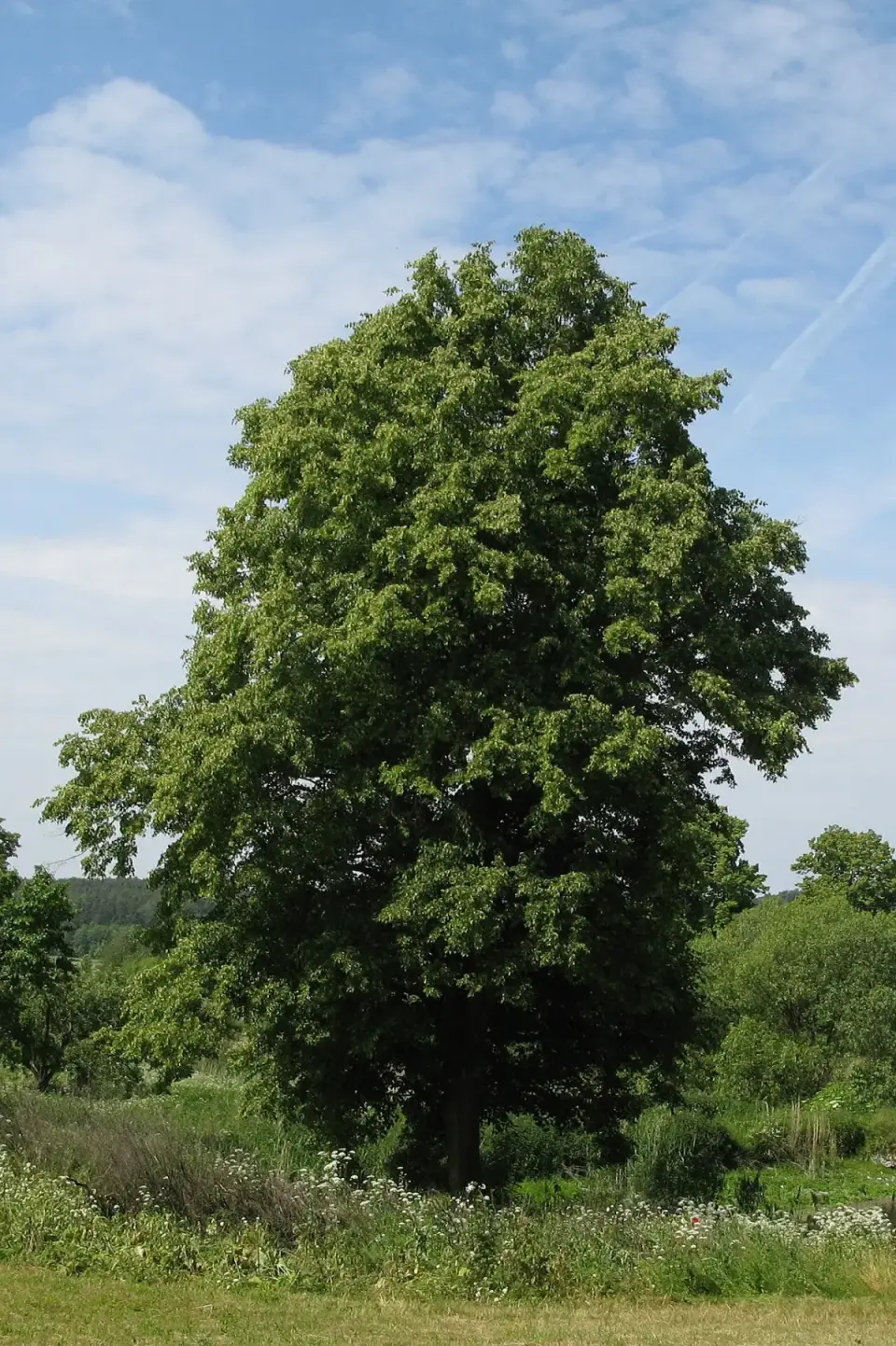
Germany · #7 tree
Small-leaved lime
Tilia cordata · locally: Winterlinde
“Am Brunnen vor dem Tore, da steht ein Lindenbaum” – the lime is the tree of German villages, songs and Berlin’s Unter den Linden.
The small-leaved lime is a stately tree growing to 30 m and living for more than a thousand years, with a dense crown and small, heart-shaped leaves that are bluish-green underneath, with rusty tufts of hairs in the vein axils. In July, a little later than the large-leaved lime, it bears fragrant, creamy-yellow flowers that attract swarms of bees. The flower clusters hang from a pale, tongue-shaped bract that acts as a wing once the fruits are ripe. The dried flowers make a tea that induces sweating, and Tilman Riemenschneider, among others, carved his altarpieces from soft limewood.
Significance in the country
The lime was the heart of the old German village: the community gathered and danced under the “Dorflinde”, and courts sat under the “Gerichtslinde”. The tree is commemorated in the song “Der Lindenbaum” from Schubert’s cycle “Winterreise”, in Berlin’s Unter den Linden boulevard and in the names of thousands of places, and in 2016 the small-leaved lime was Germany’s Tree of the Year.
Where it grows
Grows in broadleaf forests throughout Germany, more often in the east and south of the country; planted along roads, in parks and in villages from Schleswig-Holstein to Bavaria.
More: Wikipedia (en) Wikipedia (pl)