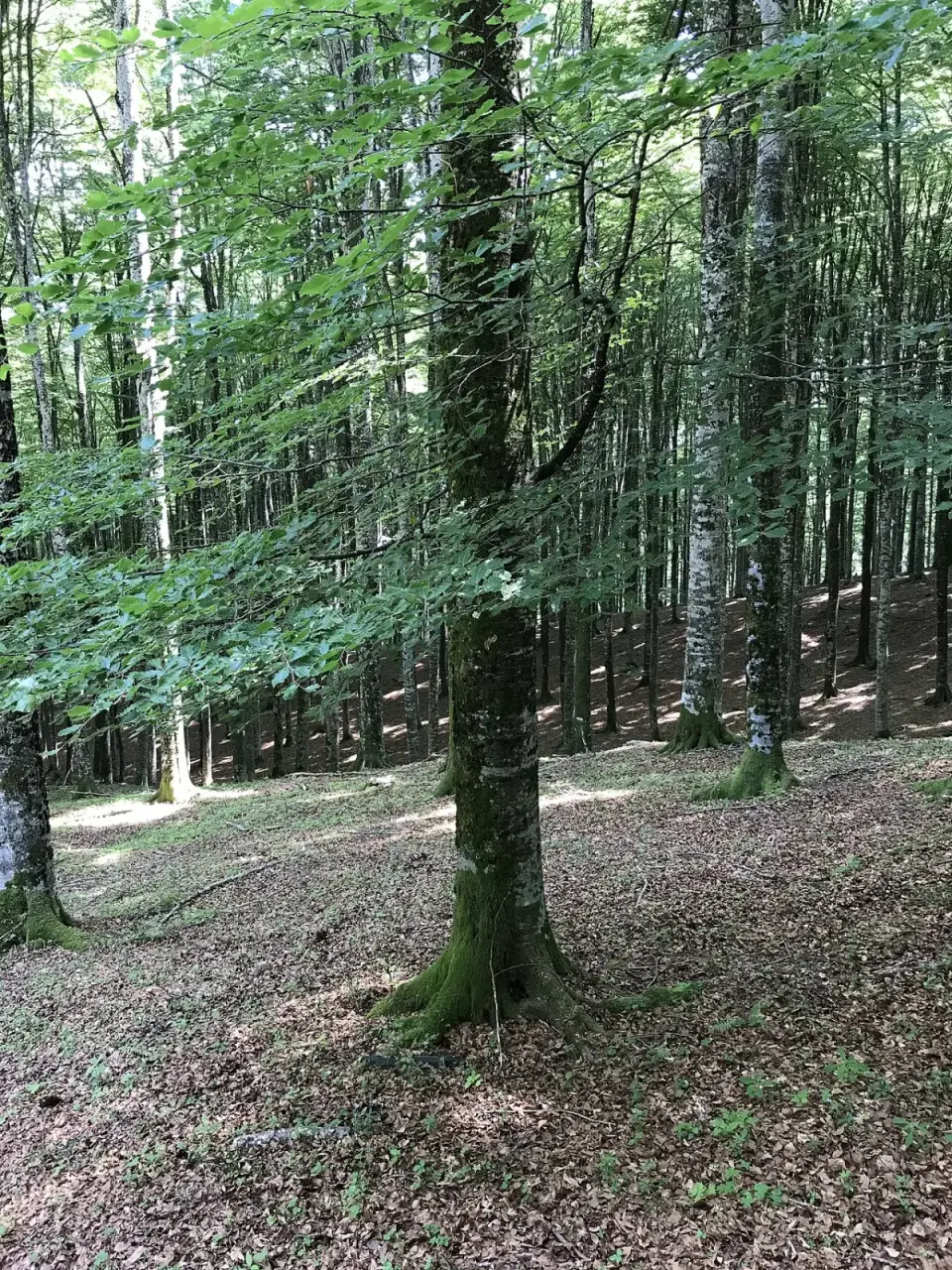
Germany · #3 tree
European beech
Fagus sylvatica · locally: Rotbuche
Without people Germany would be a land of beech forests – five German beech woods are on the UNESCO World Heritage List.
The European beech is a tall tree with smooth, silvery-grey bark and oval, glossy leaves that turn copper-coloured in autumn. It casts deep shade over the forest floor, so few shrubs grow in beech woods, and in spring, before the leaves unfold, carpets of wood anemones and wild garlic come into flower. Its nuts, known as beechmast, are an important food for wild boar, roe deer and birds. The hard beech wood is used to make furniture and plywood and as firewood.
Significance in the country
Germany lies at the centre of the beech’s range and holds the largest share of its global stock. The beech forests of Jasmund, Serrahn, Grumsin, Hainich and Kellerwald are part of the transnational UNESCO site “Ancient and Primeval Beech Forests of the Carpathians and Other Regions of Europe”.
Where it grows
Throughout the country, especially in the low mountain ranges (Hainich, Spessart, Harz, Black Forest) and in the Mecklenburg Lake District; the chalk cliffs of Jasmund on Rügen are crowned by famous coastal beech woods.
More: Wikipedia (en) Wikipedia (pl)