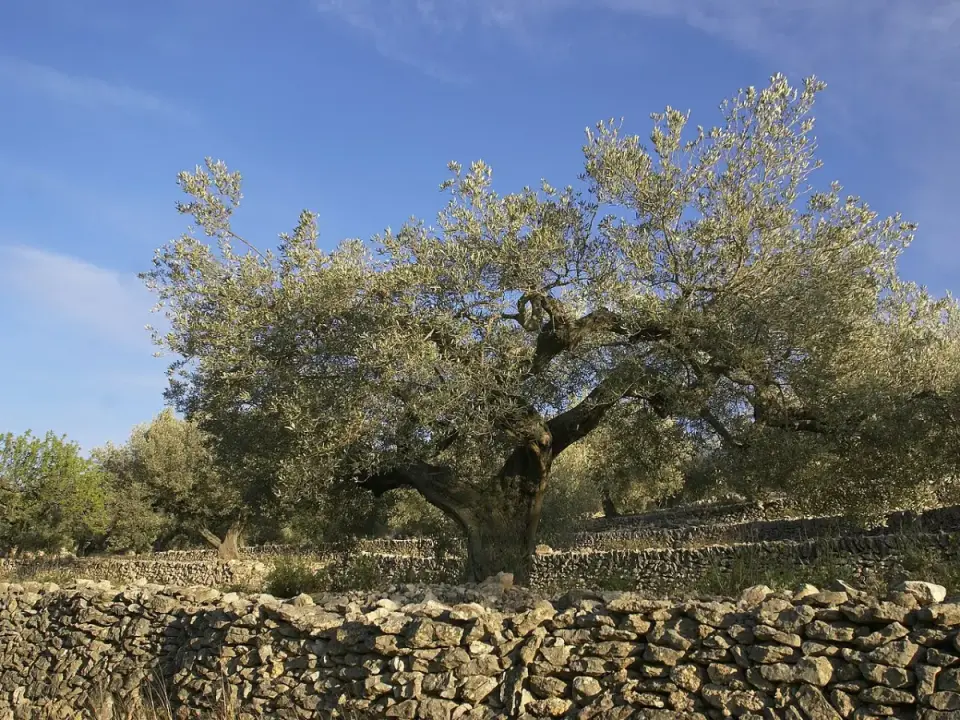
Olive (Olea europaea)
Photo: Hans Hillewaert, CC BY-SA 3.0, Wikimedia Commons

On the map in 20 countries tree symbol: Greece, Israel, Italy, Montenegro, Palestine, Vatican City

Olive

Olea europaea

Family: Oleaceae

On our map this plant appears in 20 countries and ranks highest in: Albania, Greece, Italy, Monaco, Montenegro, Palestine and others.

An evergreen tree growing to 10–15 m, with a gnarled trunk that becomes hollow with age and narrow, leathery leaves that are silvery underneath. In spring it bears small, cream-coloured flowers, and in autumn its drupes ripen – olives, green at first, then black. The tree tolerates drought and poor, stony soils and can live for more than a thousand years. The olive is one of the oldest crops of the Mediterranean basin; the fruit is pressed for oil, and firm olives are pickled in brine.

Description from: Albania.

More: Wikipedia (en) Wikipedia (pl) Plants of the World Online (Kew)

Significance in each country

  1. Albania no. 1 of 5 native

    Millions of olive trees grow in Albania, and many groves – around Berat, Vlorë and Tirana, for example – are hundreds of years old.

  2. Greece no. 1 of 10 native

    Sacred tree of Athena; the Olympic wreath

    The Greeks are among the world’s biggest consumers of olive oil, and the olive runs through their mythology, religion and cuisine.

  3. Italy no. 1 of 10 native

    Olive branch on the emblem of the Italian Republic

    Italy has over 500 olive varieties and several dozen protected designations of origin for olive oil.

  4. Monaco no. 1 of 5 introduced or naturalised

    Before tourism took off in the 19th century, the slopes above Monaco were covered with terraced olive and citrus groves and vineyards.

  5. Montenegro no. 1 of 5 native

    Stara Maslina (the Old Olive) in Bar – a natural monument

    Stara Maslina in the Mirovica district of Bar is protected as a natural monument and is a symbol of the town; according to local tradition, feuding families made peace in its shade.

  6. Palestine no. 1 of 5 native

    National tree and a symbol of Palestinians’ rootedness in the land

    Olives grow on nearly half of the cultivated land of the West Bank, and the autumn harvest (al-qataf) is a family celebration in which whole villages take part.

  7. Spain no. 1 of 10 native

    Spain usually produces about 40% of the world’s olive oil, and the olive groves of the province of Jaén form one of the largest tree monoculture landscapes on Earth. Olive oil is the foundation of Spanish cuisine and an important export.

  8. Vatican City no. 1 of 5 native

    Symbol of peace, often planted by popes

    For the Holy See the olive tree is a symbol of peace: popes plant olives during meetings with heads of state and religious leaders, and the gardens include an olive planted in 2014 by Pope Francis together with the presidents of Israel and…

  9. Israel no. 2 of 8 native

    Olive branches flank the menorah on the emblem of Israel

    The olive is one of the biblical “seven species” of the Land of Israel, and the olive branch carried by the dove in the Flood story has become a universal symbol of peace.

  10. Jordan no. 2 of 5 native

    Olive trees make up most of Jordan’s orchards, and oil from the northern uplands is a cornerstone of the cuisine and an important export. The autumn harvest is a family celebration, and fresh oil is drizzled over hummus, labneh and za’atar.

  11. Libya no. 2 of 8 native

    In Roman times Tripolitania was a powerhouse of olive oil production, and the ruins of numerous ancient oil presses survive in the Libyan interior.

  12. Tunisia no. 2 of 8 native

    Tunisia is one of the world’s largest producers and exporters of olive oil – in good years second only to Spain.

  13. Algeria no. 6 of 10 native

    Olive growing in Algeria goes back to Numidian and Roman times, and for the Kabyles an olive grove is a family heritage handed down from generation to generation.

  14. Croatia no. 6 of 8 native

    Olive oils from Istria, Cres, Krk and Korčula carry protected designations of origin, and Istrian oils regularly rank highly in international ratings.

  15. Morocco no. 6 of 10 native

    Morocco is one of the world’s leading producers of olive oil and table olives, and the most widespread variety is picholine marocaine.

  16. Portugal no. 6 of 10 native

    Olive oil – azeite in Portuguese (from the Arabic az-zayt) – is poured over bacalhau salt cod, boiled potatoes and vegetables.

  17. Syria no. 6 of 8 cultivated

    The olive is Syria’s most widely grown fruit tree, and the groves around Idlib, Afrin and Aleppo were famed for their oil and table olives.

  18. Saudi Arabia no. 9 of 10 native

    In the Al-Jouf region, thanks to deep groundwater, plantations numbering millions of trees have been established in recent decades, making Saudi Arabia a significant olive oil producer in the Middle East.

  19. France no. 10 of 10 cultivated

    Olives were already being planted on the coast of Provence by Greek colonists from Massalia, today’s Marseille.

  20. Türkiye no. 10 of 10 native

    Turkey is one of the world’s largest producers of olives and olive oil. Black olives from Gemlik and olive oil from Ayvalık and the Gulf of Edremit are Turkish classics, and a bowl of olives beside cheese and tomatoes is part of every…