Croatia · #6 crop
Olive
Olea europaea · locally: maslina
The olive groves of Istria and Dalmatia produce some of Europe’s most highly rated oils, and the wild olives of Lun on Pag form a protected reserve.
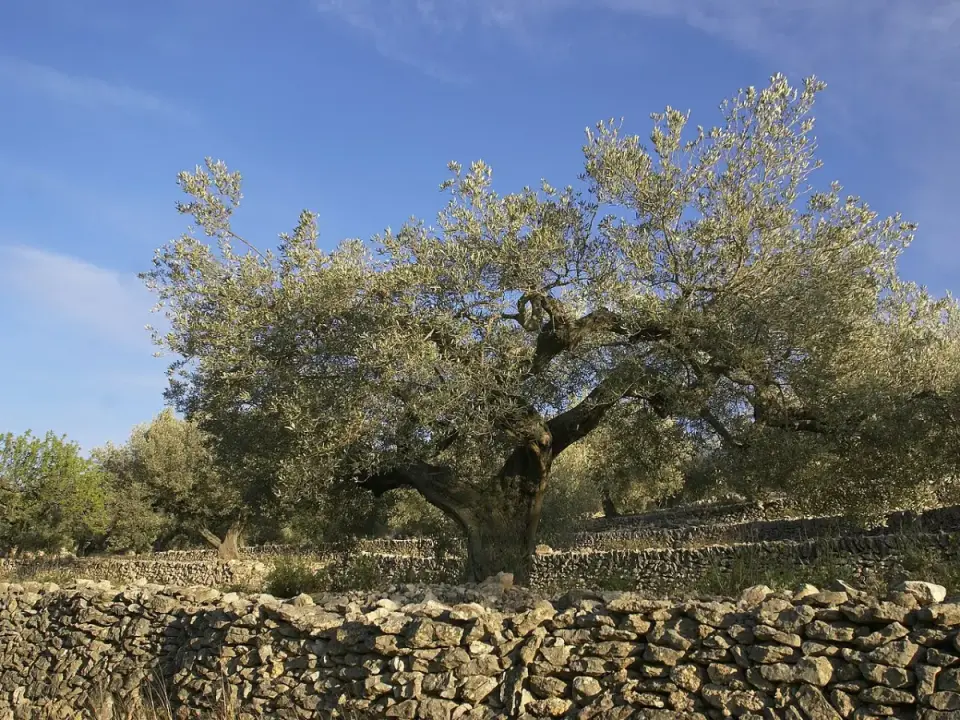
An evergreen tree with grey-green, lance-shaped leaves that are silvery underneath, and a thick trunk that becomes gnarled with age. Small, creamy-white flowers in clusters appear in late spring, and the fruits – oil-rich drupes – ripen in autumn. The tree is very long-lived and drought-tolerant but sensitive to hard frosts, so it grows in areas with a Mediterranean climate. The fruit is pressed for olive oil or, once its bitterness has been removed, eaten as table olives.
Significance in the country
Olive oils from Istria, Cres, Krk and Korčula carry protected designations of origin, and Istrian oils regularly rank highly in international ratings. At Lun on Pag there is an extensive grove of wild olives, protected as a botanical reserve.
Where it grows
Along the entire Adriatic coast and on the islands: in Istria, in the Kvarner area (Cres, Krk, Pag) and in Dalmatia – from Zadar and Šibenik to Brač, Hvar, Korčula and the Pelješac peninsula.
More: Wikipedia (en) Wikipedia (pl)