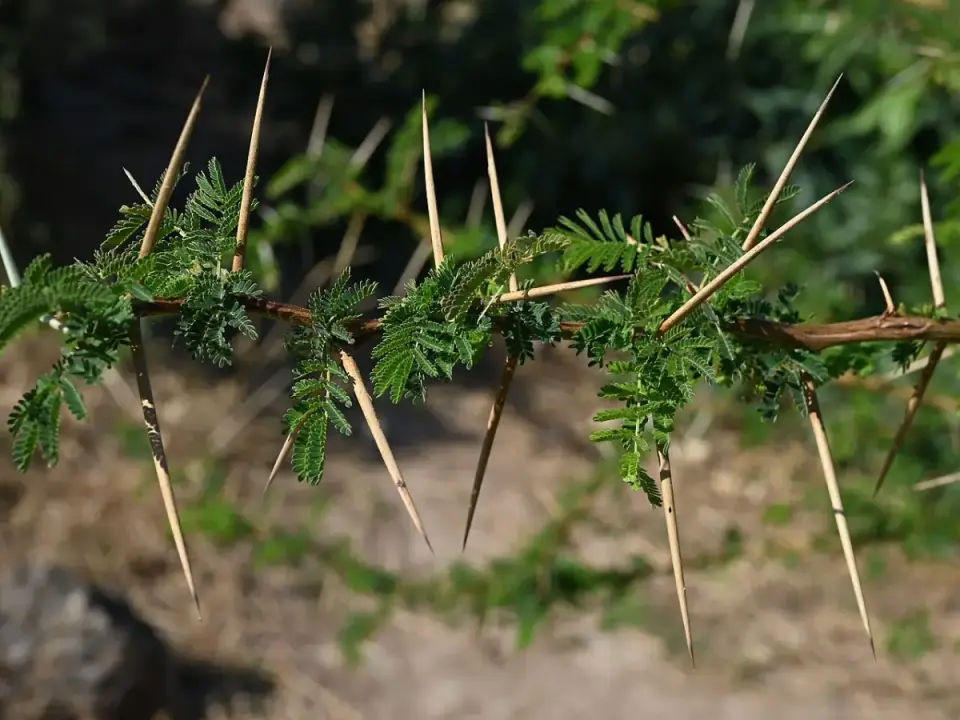
Gum arabic tree (Senegalia senegal)
Photo: Krzysztof Ziarnek, Kenraiz, CC BY-SA 4.0, Wikimedia Commons

On the map in 4 countries tree

Gum arabic tree

Senegalia senegal

Family: Fabaceae

On our map this plant appears in 4 countries and ranks highest in: Sudan, Mauritania, Senegal, Chad.

A small, thorny tree or shrub 2–6 m tall, with grey bark, pinnate leaflets and spikes of creamy-white flowers. It grows on the dry, sandy soils of savannas receiving around 300–600 mm of rain a year. In the dry season a thick resin seeps from cuts in the bark and hardens into amber lumps – this is gum arabic, used as an emulsifier and stabiliser in soft drinks, sweets, medicines and paints. The tree fixes nitrogen from the air, improving soil fertility, so it is included in crop rotations.

Description from: Sudan.

More: Wikipedia (en) Wikipedia (pl) Plants of the World Online (Kew)

Significance in each country

  1. Sudan no. 1 of 10 native

    The so-called gum belt stretches across Kordofan and Darfur as far as the Blue Nile, and gum collection provides an income for millions of farmers and herders.

  2. Mauritania no. 3 of 5 native

    In the 18th century the Dutch, French and British competed for the gum trade on the Mauritanian coast and along the Senegal River, even fighting the so-called Gum Wars. Today gum is collected on a smaller scale, mainly in Trarza and Brakna.

  3. Senegal no. 3 of 8 native

    The species name refers to Senegal, from where gum arabic was exported from the 17th century onwards – the gum trade along the Senegal River was one of the pillars of the region’s colonial economy.

  4. Chad no. 6 of 8 native

    Gum arabic has long been one of Chad’s more important exports; in this respect the country is second only to Sudan. Harvesting it in the dry season provides extra income for farmers and herders in the Sahel belt.