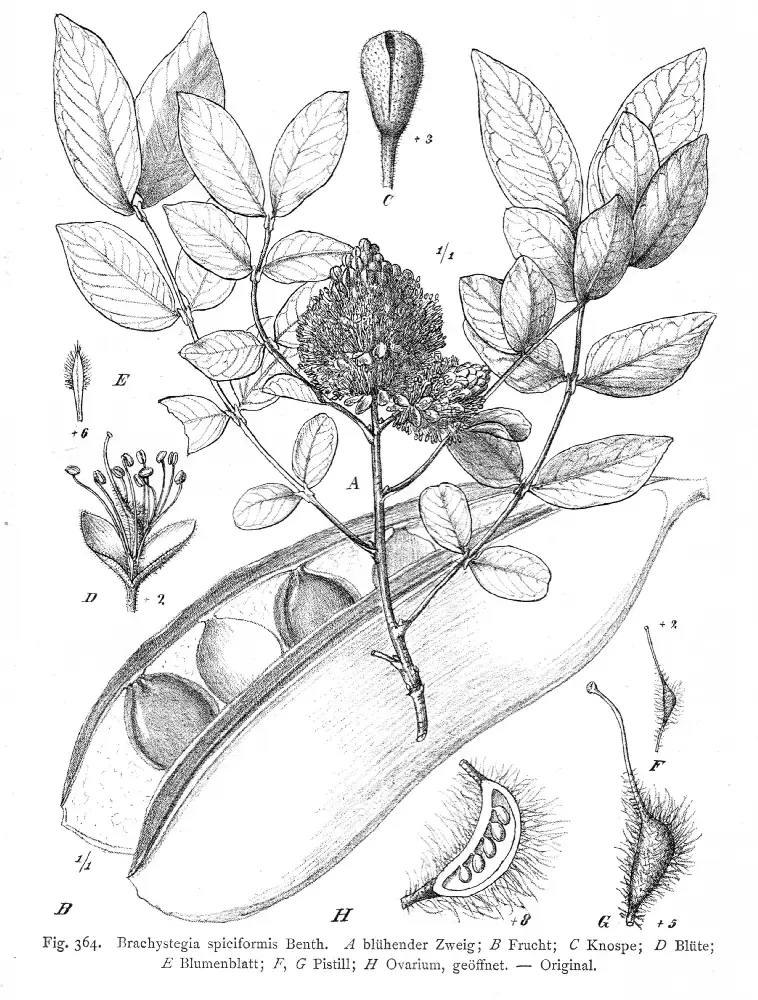
Msasa (Brachystegia spiciformis)
Photo: A. Engler, Public domain, Wikimedia Commons

On the map in 4 countries tree

Msasa

Brachystegia spiciformis

Family: Fabaceae

On our map this plant appears in 4 countries and ranks highest in: Zambia, Zimbabwe, Angola, Tanzania.

The msasa is a medium-sized tree of the legume family, reaching 10–15 m, with an umbrella-shaped crown and pinnate leaves. Just before the rains arrive, in September and October, it puts out young leaves in shades of red, pink and brown that turn green only later – the so-called “miombo spring”. It grows on the poor, acid soils of the plateau, forming open woodland with a grassy understorey together with related species. Its hard wood is used for firewood and charcoal, and its bark is made into rope and containers.

Description from: Zambia.

More: Wikipedia (en) Plants of the World Online (Kew)

Significance in each country

  1. Zambia no. 1 of 8 native

    Miombo woodland with msasa covers most of Zambia and provides people with wood, honey, mushrooms and edible ifinkubala caterpillars. Its rapid conversion into fields and charcoal is one of the country’s main conservation problems.

  2. Zimbabwe no. 2 of 8 native

    The msasa is the most characteristic tree of the Zimbabwean highveld, and the “msasa spring” is for local people a sign of the coming rainy season. The Msasa suburb of Harare, among other places, is named after the tree.

  3. Angola no. 4 of 10 native

    Miombo covers much of Angola’s central plateau and provides the Ovimbundu and Chokwe peoples with wood, wild honey, mushrooms and fruit; felling for charcoal to supply the cities is now its main threat.

  4. Tanzania no. 10 of 10 native

    Miombo woodland covers much of western, central and southern Tanzania and is a stronghold for wildlife in Ruaha and Katavi national parks and in the Nyerere reserve (formerly Selous).