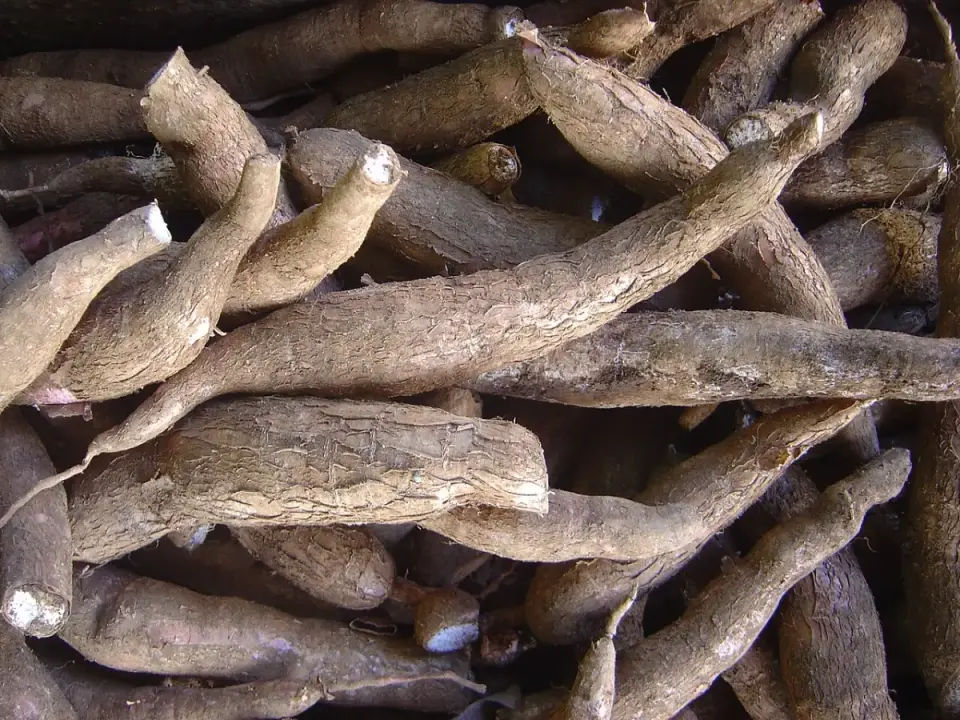
Cassava (Manihot esculenta)
Photo: David Monniaux, CC BY-SA 3.0, Wikimedia Commons

On the map in 11 countries crop

Cassava

Manihot esculenta

Family: Euphorbiaceae

On our map this plant appears in 11 countries and ranks highest in: DR Congo, Central African Republic, Republic of the Congo, Angola, Ghana, Nigeria and others.

Cassava is a shrub of the spurge family, growing to 2–3 m, with palmately divided leaves and thick, starchy tuberous roots that can weigh several kilograms. It is propagated from pieces of stem, and the plants cope well with drought and poor soils. The roots contain cyanogenic glycosides – bitter varieties must be grated, squeezed and toasted or fermented before eating, whereas sweet ones need only be boiled. The species was domesticated thousands of years ago in the south-western Amazon, from where it spread throughout the tropics.

Description from: Brazil.

More: Wikipedia (en) Wikipedia (pl) Plants of the World Online (Kew)

Significance in each country

  1. DR Congo no. 3 of 10 cultivated

    Cassava is the staple food of tens of millions of Congolese: its flour is made into fufu and kwanga, and pondu – cassava leaves cooked with palm oil and fish – is one of the most characteristic dishes of Kinshasa.

  2. Central African Republic no. 4 of 5 cultivated

    Cassava is the mainstay of the Central African Republic’s diet: flour from the dried roots makes gozo, the main accompaniment to meals, and the young leaves are cooked with groundnuts.

  3. Republic of the Congo no. 5 of 5 cultivated

    Chikwangue – a steamed paste of fermented cassava wrapped in leaves – and saka-saka made from pounded leaves are Congolese classics; cassava is grown on almost every farm.

  4. Angola no. 6 of 10 cultivated

    Angola is one of Africa’s largest cassava producers. Funje made from cassava flour is the staple of cooking in the north of the country, and the young leaves are used to make the popular dish kizaca.

  5. Ghana no. 6 of 8 cultivated

    Ghana is one of Africa’s largest cassava producers. Fufu, pounded in wooden mortars and served with groundnut or palm-nut soup, is a symbol of Ashanti cuisine, and fermented cassava is also an ingredient of banku.

  6. Nigeria no. 6 of 10 cultivated

    Nigeria harvests tens of millions of tonnes of cassava every year – more than any other country.

  7. Paraguay no. 6 of 8 cultivated

    Mandi’o is to Paraguay what bread is to Europe – the boiled roots are served with asado, soups and almost every dish.

  8. Brazil no. 7 of 15 native

    Mandioca was the staple food of the Tupi and Guarani peoples, from whom the Portuguese learned how to process it.

  9. Côte d’Ivoire no. 7 of 8 cultivated

    Attiéké – grated, fermented and steamed cassava, traditionally made by women of the lagoon peoples such as the Ebrié and Adjoukrou – is served with grilled fish and onion.

  10. Mozambique no. 7 of 8 cultivated

    The Portuguese brought cassava to East Africa, and today it is a staple food, especially in the north of the country.

  11. Cuba no. 10 of 10 cultivated

    The Taíno baked flat casabe cakes from grated cassava, which served the colonists as a long-lasting bread for expeditions.