Rubber tree (Hevea brasiliensis)
Photo: Vis M, CC BY-SA 4.0, Wikimedia Commons

On the map in 6 countries tree

Rubber tree

Hevea brasiliensis

Family: Euphorbiaceae

On our map this plant appears in 6 countries and ranks highest in: Liberia, Brazil, Thailand, Malaysia, Côte d’Ivoire, Sri Lanka.

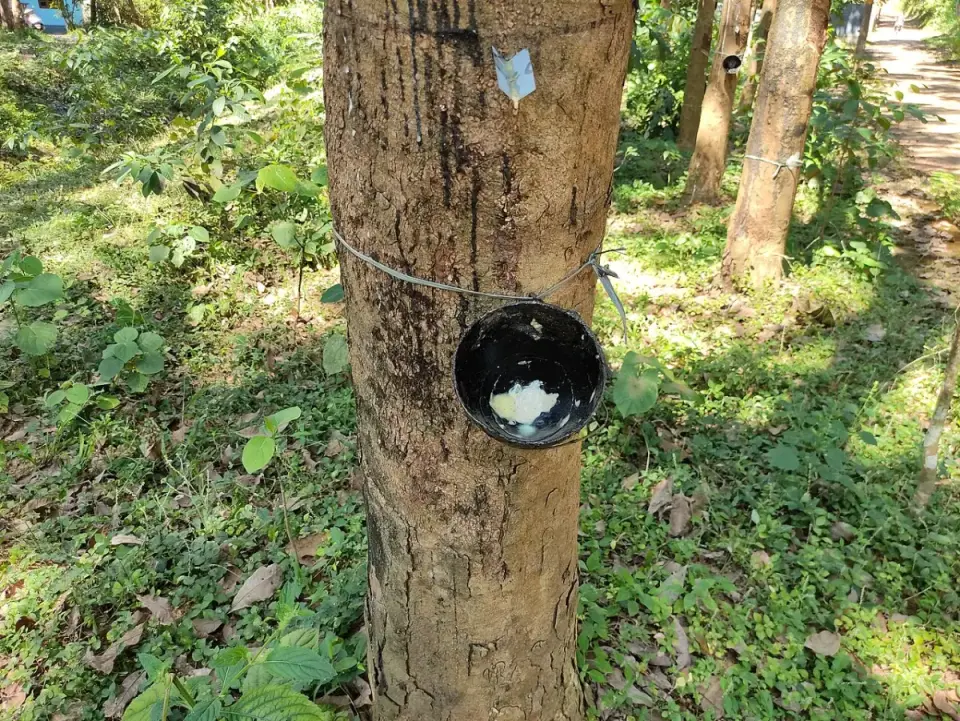
The rubber tree is a member of the spurge family, growing to 20–40 m, with trifoliate leaves and fruits that explode with a crack to scatter their seeds. Milky latex flows in its bark and is collected by cutting a spiral into the trunk and catching the sap in small cups. Once coagulated, the latex yields natural rubber – the raw material for tyres, gloves and many other rubber goods. In the wild it grows scattered through the forests of the Amazon basin, while in cultivation in South-East Asia it forms vast plantations.

Description from: Brazil.

More: Wikipedia (en) Wikipedia (pl) Plants of the World Online (Kew)

Significance in each country

  1. Liberia no. 3 of 5 cultivated

    In 1926 the American company Firestone obtained a huge concession in Liberia and established a plantation at Harbel that was the largest in the world for decades.

  2. Brazil no. 5 of 15 native

    The rubber boom (about 1879–1912) brought wealth to Manaus and Belém, crowned by the Teatro Amazonas opera house; it ended when seeds taken to Asia produced cheaper plantations.

  3. Thailand no. 6 of 10 cultivated

    The rubber tree was brought to southern Siam at the beginning of the 20th century, and today Thailand produces about a third of the world’s natural rubber.

  4. Malaysia no. 7 of 10 cultivated

    Seeds taken from Brazil reached Asia via Kew Gardens, and in 1877 the first trees were planted in Kuala Kangsar in Perak – one of them still grows there today.

  5. Côte d’Ivoire no. 8 of 8 cultivated

    Côte d’Ivoire is Africa’s largest rubber producer and one of the leading producers in the world; in recent decades the crop has expanded very rapidly and provides a living for many smallholders.

  6. Sri Lanka no. 9 of 10 cultivated

    Rubber seeds taken from Brazil and raised at Kew reached the botanic garden at Henarathgoda in 1876, from where cultivation spread across Ceylon and South-East Asia.