Poland · #11 tree
European beech
Fagus sylvatica · locally: buk zwyczajny
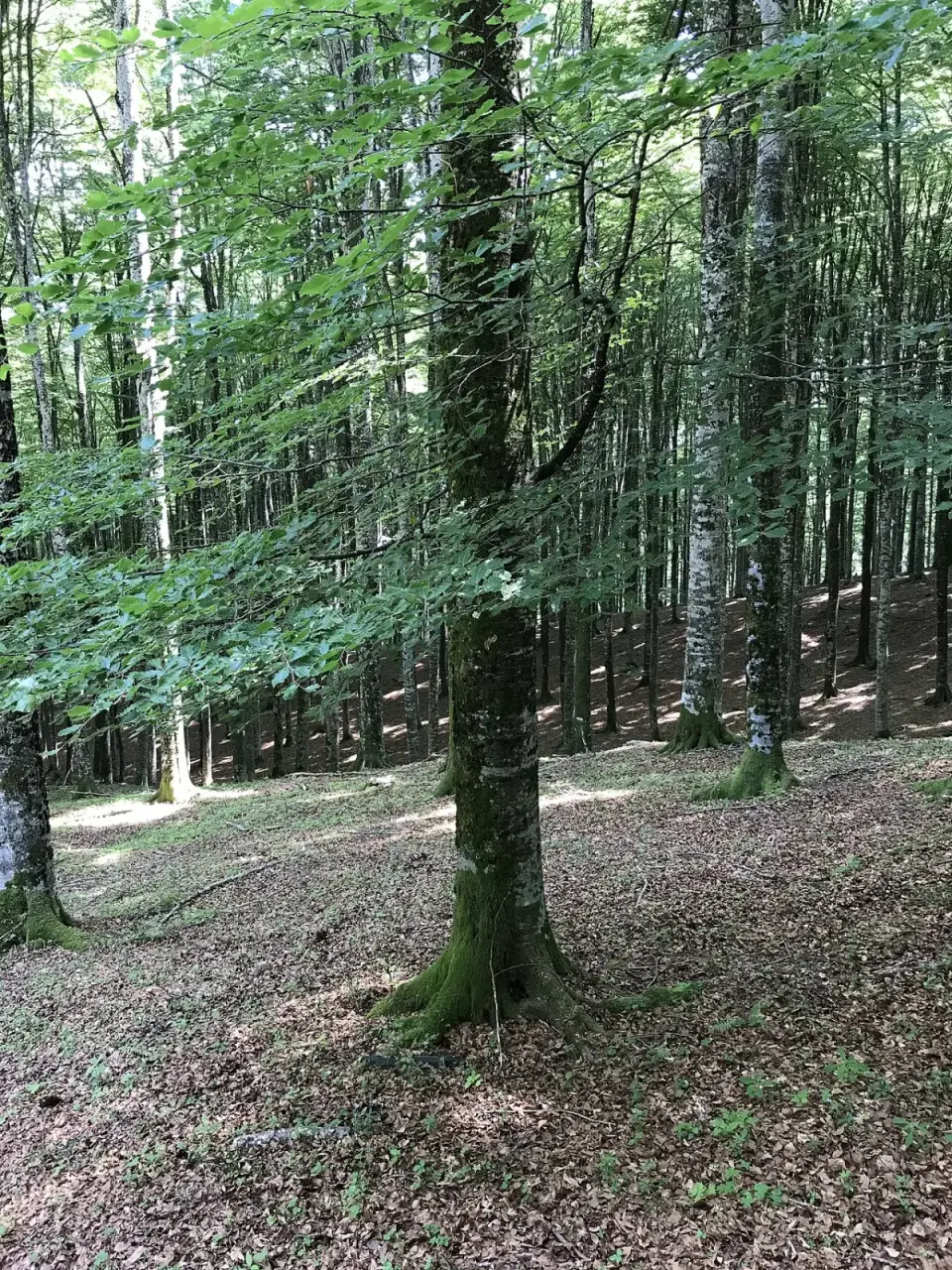
Smooth, silvery-grey beech trunks form the “cathedral” forests of Pomerania, the Sudetes, the Beskids and the Bieszczady – Poland’s grandest broadleaf woods.
The European beech is a broadleaf tree growing to 40 m in height, with smooth, ash-grey bark that does not crack even on very old trees. Its ovate, wavy-edged leaves turn copper and gold in autumn, and its fruits are three-sided, oily nuts – beechnuts – enclosed in a spiny husk. The dense crown lets little light through, so in closed beech forests the undergrowth is sparse and develops mainly in spring, before the trees come into leaf. Its hard, pale wood is used for furniture, plywood and parquet flooring and as firewood, and its smoke gives flavour to smoked meats and cheeses.
Significance in the country
The north-eastern limit of the beech’s range runs through Poland, so it is naturally absent from Podlasie, most of Masovia and eastern Masuria, while in Pomerania, on Wolin and in the mountains it forms extensive beech forests. In 2021 the Carpathian beech forests of Bieszczady National Park were added to the UNESCO World Heritage List as part of the “Ancient and Primeval Beech Forests of the Carpathians and Other Regions of Europe”.
Where it grows
West and south of the range limit, which runs from Warmia (around Olsztyn) through Kuyavia, the Łódź region and the Lublin region to Roztocze; the largest beech forests grow in Pomerania and on Wolin, in the Sudetes, the Beskids and the Bieszczady. It does not occur naturally in Podlasie, most of Masovia or eastern Masuria.
More: Wikipedia (en) Wikipedia (pl)