Canada · #7 tree Provincial tree of Saskatchewan (since 1988)
Paper birch
Betula papyrifera · locally: paper birch / bouleau à papier
A birch with snow-white, peeling bark, from which Canada’s Indigenous peoples built lightweight canoes.
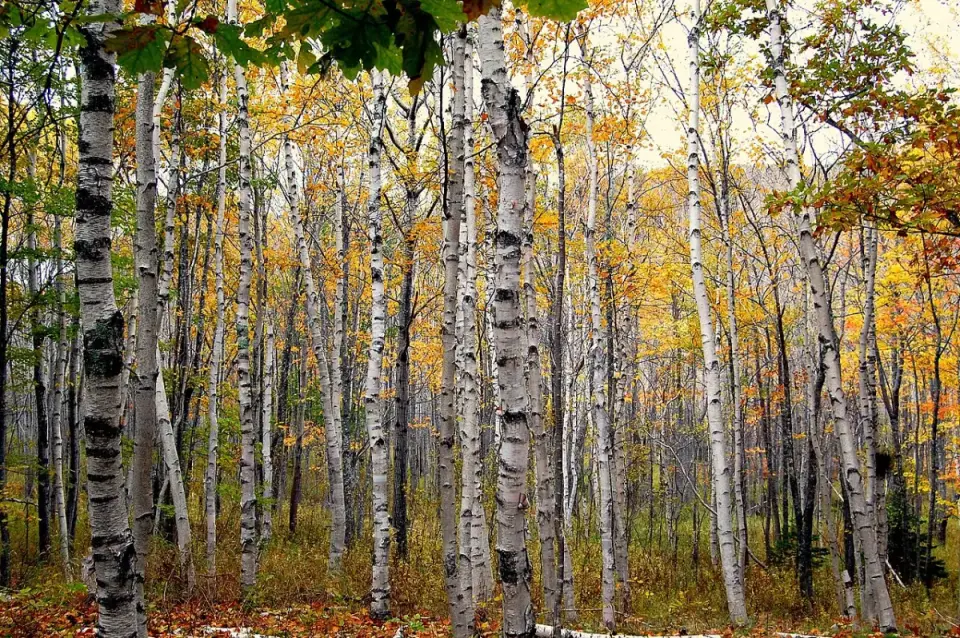
The paper birch is a broadleaf tree growing to 20–25 m, with chalk-white bark that peels in thin horizontal strips like sheets of paper. It has oval, toothed leaves that turn yellow in autumn, and small, hanging catkin-like fruiting heads. As a pioneer species it quickly colonises burnt ground, clear-cuts and abandoned fields, forming light woods with aspens in the boreal zone. Its waterproof, flexible and rot-resistant bark has been used for thousands of years to make containers, shelter coverings and canoes.
Significance in the country
The birchbark canoe, invented by the Indigenous peoples of the northern forests, made it possible to explore the country and trade furs – and it has become one of Canada’s symbols. White birch trunks among dark spruces are a classic image of the Canadian forest, captured by painters and photographers.
Where it grows
Across almost all the forested part of the country – from Yukon and British Columbia to Newfoundland; in the north it reaches the treeline, but it is absent from the tundra of Nunavut.
More: Wikipedia (en) Wikipedia (pl)