Botswana · #1 tree
African baobab
Adansonia digitata · locally: mowana
Baines’ Baobabs on the edge of the white Nxai Pan are among Africa’s most famous landscapes, immortalised by a 19th-century painter.
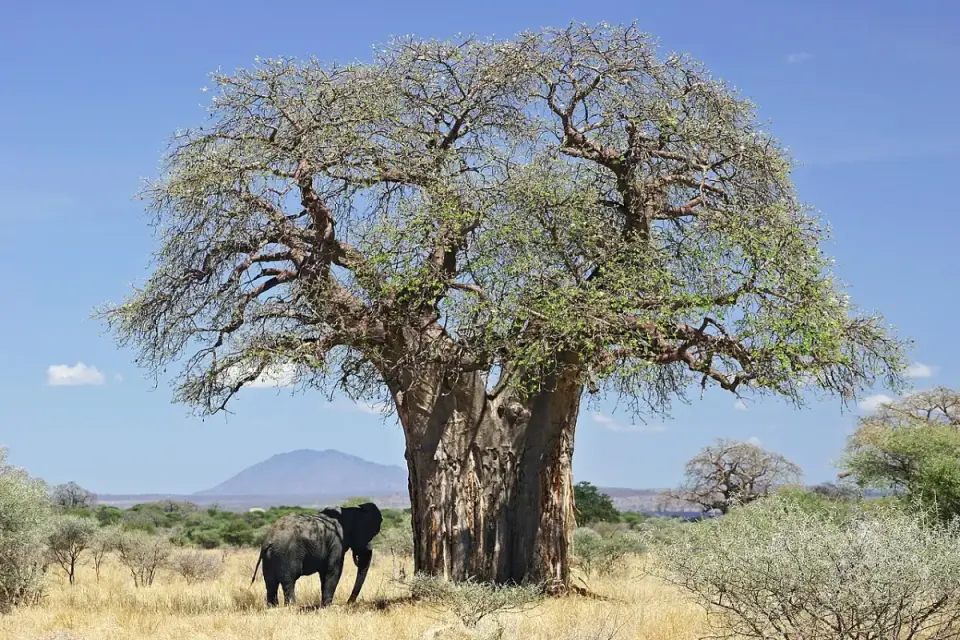
The African baobab is a tree with a huge, barrel-shaped trunk that can exceed 20 m in girth and stores water for the long dry season. For most of the year it stands leafless, its branches looking more like roots. The heavy white flowers open at night and are pollinated by bats. The fruit holds a tangy, powdery pulp rich in vitamin C, and the leaves and seeds are edible too. The oldest baobabs are more than a thousand years old, making them among the longest-lived flowering trees.
Significance in the country
Solitary baobabs around the Makgadikgadi and Nxai pans once served early travellers as landmarks – inscriptions carved in the 19th century can still be seen on the trunk of Green’s Baobab. The group known as Baines’ Baobabs, painted by Thomas Baines in 1862, looks almost exactly the same today.
Where it grows
Northern and east-central Botswana: around the Makgadikgadi and Nxai pans (Central District, Sowa), the north-east of the country, and the fringes of the Okavango Delta and the Chobe area.
More: Wikipedia (en) Wikipedia (pl)