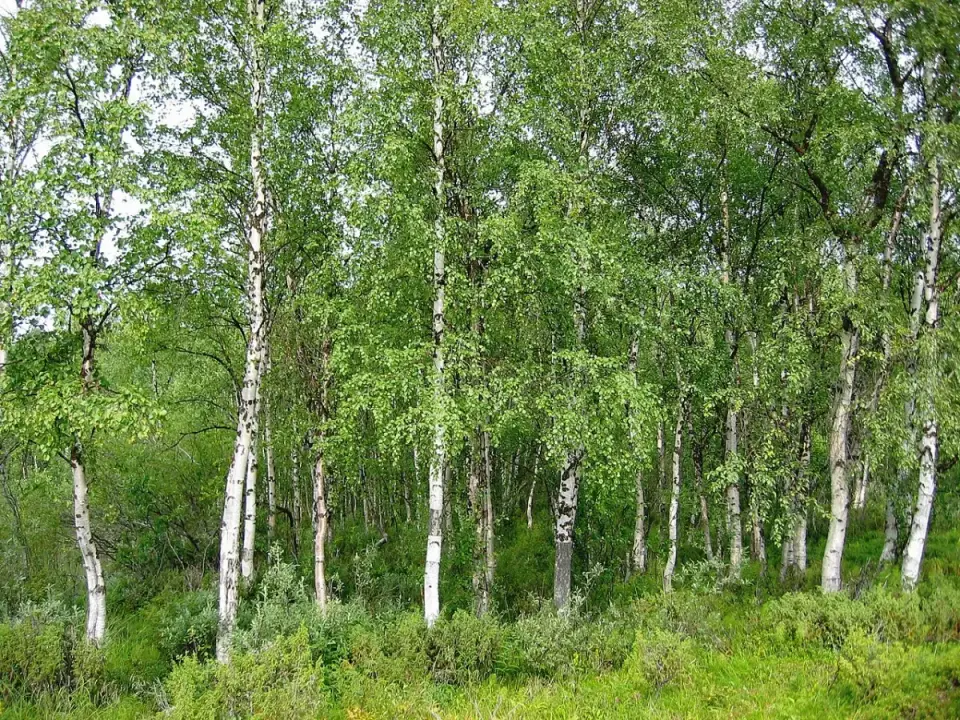
Silver birch (Betula pendula)
Photo: Percita at Flickr, CC BY-SA 2.0, Wikimedia Commons

On the map in 9 countries tree symbol: Finland, Russia

Silver birch

Betula pendula

Family: Betulaceae

On our map this plant appears in 9 countries and ranks highest in: Russia, Finland, Latvia, Belarus, Estonia, Lithuania and others.

A tree growing to 25–30 m, with distinctive white bark that peels off in thin sheets and, on older trees, becomes cracked and black at the base. Its slender twigs, covered in wart-like glands, hang down in arches, and its triangular, double-toothed leaves turn gold in autumn. It is a pioneer species – one of the first to colonise burnt ground and abandoned fields. Its bark was made into vessels and used for writing (the famous Novgorod birch-bark letters), birch sap is tapped in spring, and the twigs are made into whisks for the banya.

Description from: Russia.

More: Wikipedia (en) Wikipedia (pl) Plants of the World Online (Kew)

Significance in each country

  1. Russia no. 1 of 15 native

    Unofficial national tree of Russia

    In Russia the birch is a symbol of the homeland and of Russian nature – it appears in folk songs, in the poems of Sergei Yesenin and in the paintings of Levitan.

  2. Finland no. 2 of 10 native

    National tree of Finland (since 1988)

    The silver birch was proclaimed Finland’s national tree in 1988. Its young twigs are bound into a vihta (or vasta) used in the sauna, and Finnish birch wood is the mainstay of the plywood industry and of Alvar Aalto’s famous furniture…

  3. Latvia no. 4 of 8 native

    The birch is the commonest broadleaf tree in Latvian forests, and Latvian birch plywood is exported all over the world.

  4. Belarus no. 7 of 8 native

    Birch is the second most important forest-forming tree in Belarus after pine. Birch sap, drunk fresh or fermented, is a traditional spring drink, and birch twigs are used to make sauna whisks and to decorate houses at Pentecost (Troitsa).

  5. Estonia no. 7 of 8 native

    On Jaanipäev young birches are set up by the doors of houses and at gates, and in spring people drink birch sap (kasemahl).

  6. Lithuania no. 7 of 8 native

    In Lithuania’s most famous fairy tale, “Eglė, Queen of Serpents”, the heroine’s sons turn into an oak, an ash and a birch – Beržas is the birch.

  7. Poland no. 7 of 15 native

    The birch carries rich symbolism in Poland – crosses on soldiers’ graves were made from birch trunks, and a birch wood became the subject of a story by Jarosław Iwaszkiewicz and a film by Andrzej Wajda (“The Birch Wood”).

  8. Sweden no. 7 of 10 native

    The birch is Sweden’s commonest broadleaf tree and an inseparable part of its customs – at Easter, påskris twigs decorated with coloured feathers are put in vases, and at Midsummer birch leaves decorate doors and the maypole.

  9. Kazakhstan no. 9 of 10 native

    Birch and aspen–birch copses are the most common woodlands of northern Kazakhstan – they break up the farmed steppe and shelter fields from the wind. Birch is also often planted in northern cities, including Astana.