Malaysia · #7 tree
Rubber tree
Hevea brasiliensis · locally: getah
The Brazilian tree that built the wealth of colonial Malaya – rubber from Malayan plantations went into tyres all over the world.
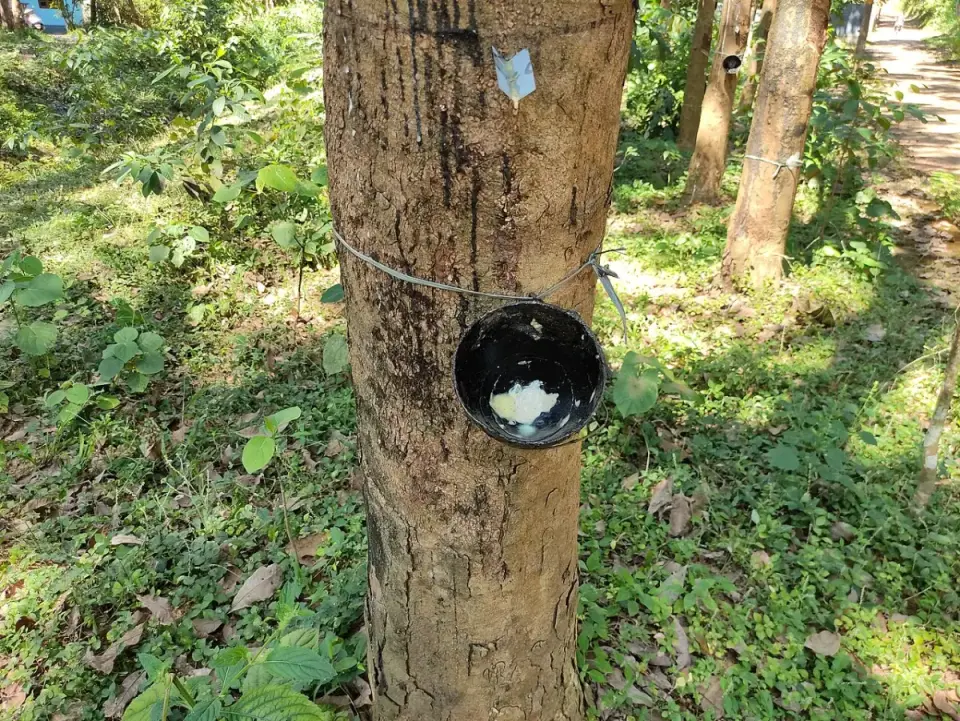
The rubber tree is a fast-growing tree of the spurge family, native to the Amazon basin, with pale, smooth bark and trifoliate leaves on long stalks. Latex vessels filled with white latex run through the bark; the latex is harvested by cutting slanting grooves into the bark and collecting the sap that oozes out in cups fixed to the trunk. Coagulated latex becomes natural rubber, used to make tyres, gloves and other rubber goods. Plantation trees are usually tapped for about 25–30 years.
Significance in the country
Seeds taken from Brazil reached Asia via Kew Gardens, and in 1877 the first trees were planted in Kuala Kangsar in Perak – one of them still grows there today. Thanks to the bark-tapping method developed by Henry Ridley, Malaya became the world’s largest rubber producer in the 20th century, and today Malaysia leads the world in the production of rubber gloves.
Where it grows
Plantations and smallholdings stretch across the whole Malay Peninsula – especially in Kedah, Kelantan, Negeri Sembilan, Johor and Pahang – as well as in Sarawak and Sabah.
More: Wikipedia (en) Wikipedia (pl)