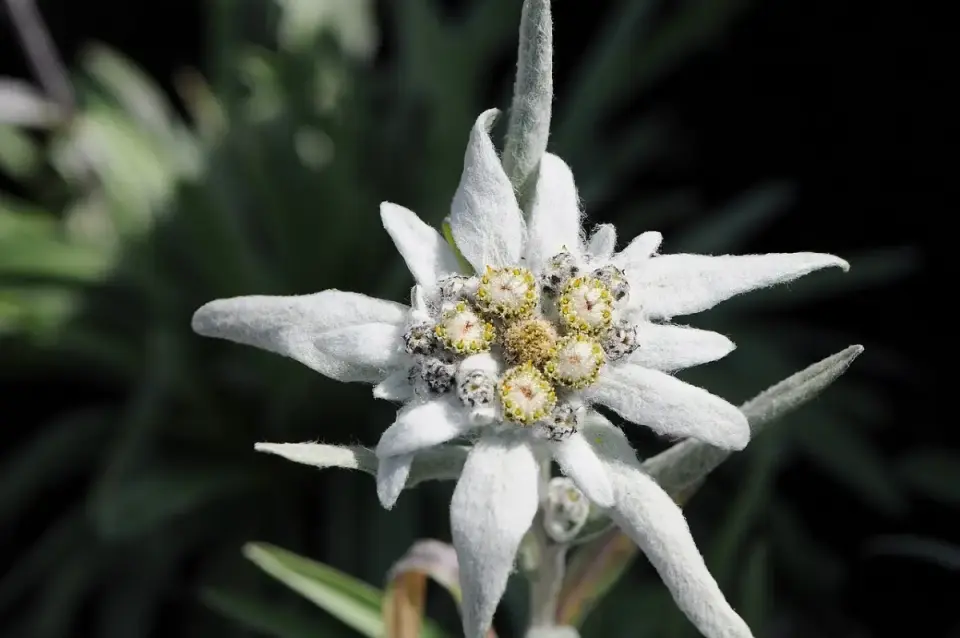
Edelweiss (Leontopodium nivale subsp. alpinum)
Photo: Böhringer Friedrich, CC BY-SA 2.5, Wikimedia Commons

On the map in 4 countries flower symbol: Austria, Romania, Switzerland

Edelweiss

Leontopodium nivale subsp. alpinum

Family: Asteraceae

On our map this plant appears in 4 countries and ranks highest in: Austria, Romania, Switzerland, Slovakia.

Edelweiss is a low perennial covered in dense white woolly hairs that protect it from frost, wind and intense sunlight. Its distinctive “star” is formed by felted bracts surrounding several tiny, yellowish flower heads. It grows on limestone rocks, in crevices and on stony grassland, mostly at 1,800–3,000 m. Mass picking had already made it rare by the 19th century, and it is now strictly protected.

Description from: Austria.

More: Wikipedia (en) Wikipedia (pl) Plants of the World Online (Kew)

Significance in each country

  1. Austria no. 1 of 8 native

    National flower of Austria; appears on the 2-euro-cent coin

    In 1907 Emperor Franz Joseph granted the edelweiss as a badge to Austria’s mountain riflemen, and the Austrian army’s mountain units still wear it today.

  2. Romania no. 1 of 10 native

    Symbol of the Romanian Carpathians and one of the first protected species in Romania

    Edelweiss was one of the first plants in Romania to be given legal protection as a natural monument (1933).

  3. Switzerland no. 1 of 8 native

    National flower of Switzerland

    In the 19th century, picking edelweiss from an inaccessible cliff was seen as proof of courage and love, which made it a symbol of the Alps.

  4. Slovakia no. 5 of 8 native

    In Slovakia edelweiss is a symbol of the high mountains and wild nature, and picking it has been forbidden for decades. Most of its sites are in the inaccessible Belianske Tatras, which are largely closed to tourists.