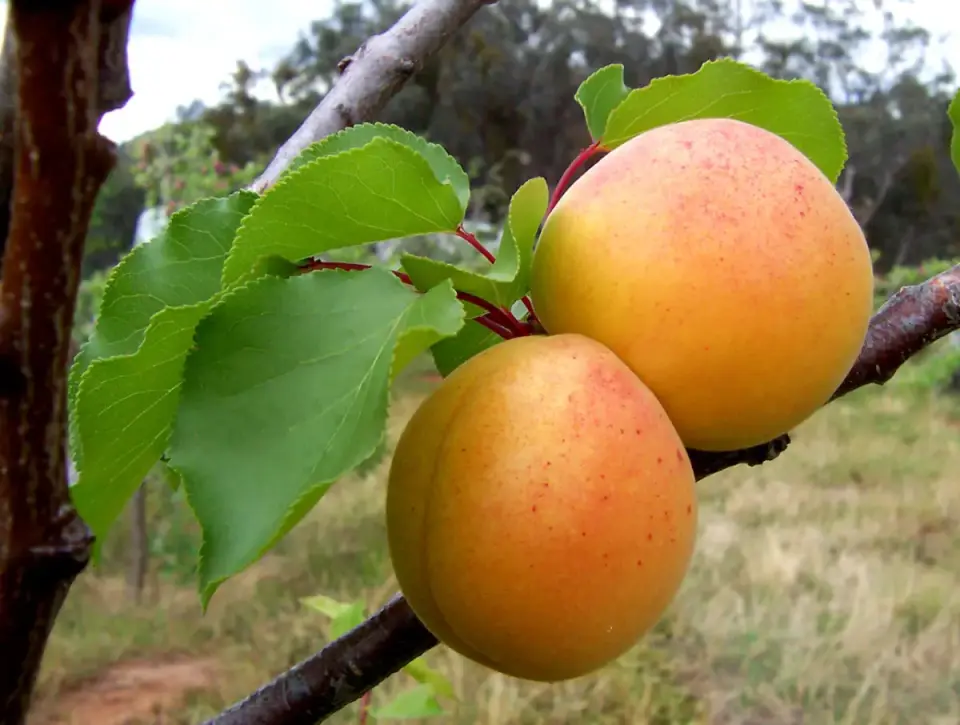
Apricot (Prunus armeniaca)
Photo: Fir0002, CC BY-SA 3.0, Wikimedia Commons

On the map in 9 countries crop symbol: Armenia

Apricot

Prunus armeniaca

Family: Rosaceae

On our map this plant appears in 9 countries and ranks highest in: Armenia, Tajikistan, Kyrgyzstan, Austria, Hungary, Syria and others.

The apricot is a small tree with a broad crown, heart-shaped leaves and pinkish-white flowers that appear in early spring, before the leaves. The fruits are velvety orange drupes with sweet, aromatic flesh. The tree copes well with dry, hot summers and frosty winters. The fruit is eaten fresh or dried – as dried apricots and uryuk – and oil is pressed from the kernels.

Description from: Kyrgyzstan.

More: Wikipedia (en) Wikipedia (pl) Plants of the World Online (Kew)

Significance in each country

  1. Armenia no. 1 of 5 introduced or naturalised

    National fruit of Armenia – the orange stripe of the flag is sometimes linked to its colour

    For Armenians the apricot is the national fruit: the duduk is made from apricot wood, and dried apricots and apricot brandy are the most popular souvenirs from Armenia.

  2. Tajikistan no. 1 of 5 cultivated

    Apricots are Tajikistan’s most important fruit, and apricots drying on rooftops are a summer sight in the villages of the Fergana Valley.

  3. Kyrgyzstan no. 4 of 5 native

    Batken Region is the centre of Kyrgyz apricot growing, and apricots drying on rooftops and in courtyards are a typical summer sight in its villages. Apricots are one of southern Kyrgyzstan’s main exports.

  4. Austria no. 5 of 8 cultivated

    “Wachauer Marille” is a protected designation of origin for apricots from the Wachau valley on the Danube – a cultural landscape on the UNESCO World Heritage List.

  5. Hungary no. 6 of 8 cultivated

    The Hungarian name “kajszi” comes from Turkish, and apricots have been grown here for centuries.

  6. Syria no. 7 of 8 introduced or naturalised

    Damascus apricots have been famous in the Arab world for centuries, and qamar al-din – sun-dried sheets of apricot purée – is dissolved in water to make a drink for breaking the fast during Ramadan.

  7. Türkiye no. 7 of 10 cultivated

    Turkey harvests more apricots than any other country and is the largest exporter of dried apricots, the vast majority of which come from around Malatya – a city known as the apricot capital, which holds an apricot festival every year.

  8. Uzbekistan no. 8 of 8 native

    Uzbekistan is one of the world’s leading apricot producers, and dried apricots – stoned as kuraga, with the stone as o‘rik – are sold at every bazaar and exported to many countries.

  9. Pakistan no. 9 of 10 introduced or naturalised

    Apricots are a symbol of Gilgit-Baltistan: in Hunza and Baltistan they are dried on the roofs of houses, and kernel oil is used in cooking and skin care.