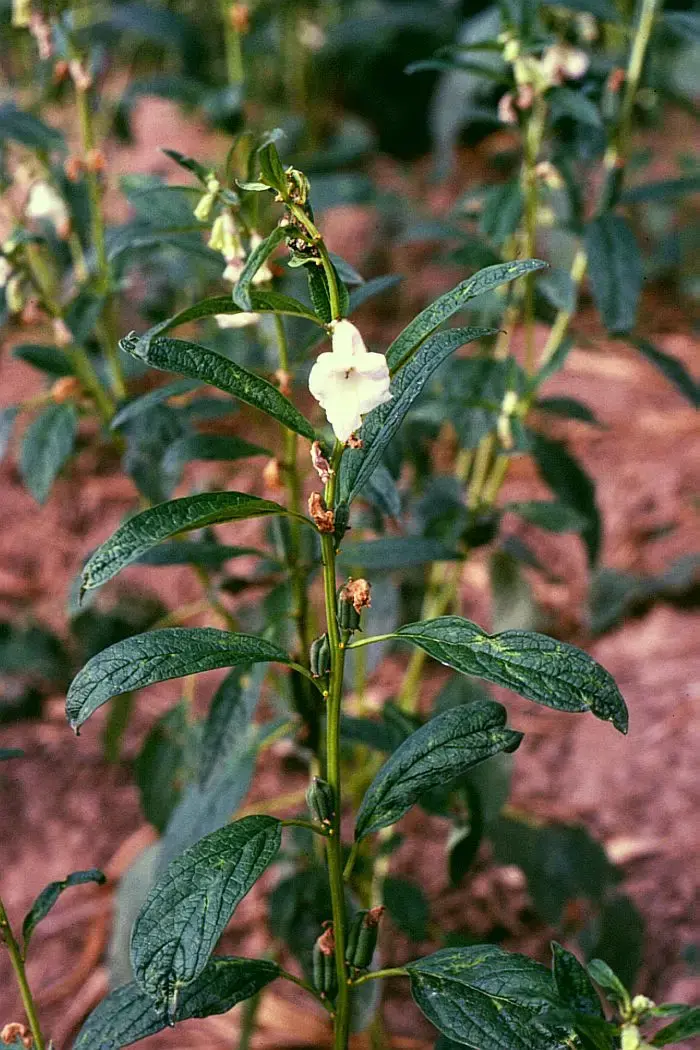
Sudan · #9 crop
Sesame
Sesamum indicum · locally: simsim (سمسم)
Sudan is one of the world’s leading producers and exporters of sesame – grown by smallholders throughout the summer-rainfall belt.
An annual oil crop growing to 1–1.5 m, with a hairy, four-angled stem and bell-shaped white or pinkish flowers borne singly in the leaf axils. The fruit is an elongated capsule that splits open when ripe, scattering small, flat seeds – white, brown or black. The seeds contain about 50% oil, which is highly resistant to going rancid, as well as plenty of protein and calcium. It is one of the oldest oil crops, cultivated for thousands of years in South Asia and Africa.
Significance in the country
For years Sudan has been one of the world’s largest sesame producers, and its exports are one of the country’s more important sources of income, supporting hundreds of thousands of farmers. Locally it is pressed for cooking oil, and the seeds go into halva, tahini paste and baked goods.
Where it grows
Grown in the rainy season on the heavy clays of Gedaref and Blue Nile, in Sennar and White Nile, and on the sandy soils of Kordofan and Darfur.
More: Wikipedia (en) Wikipedia (pl)