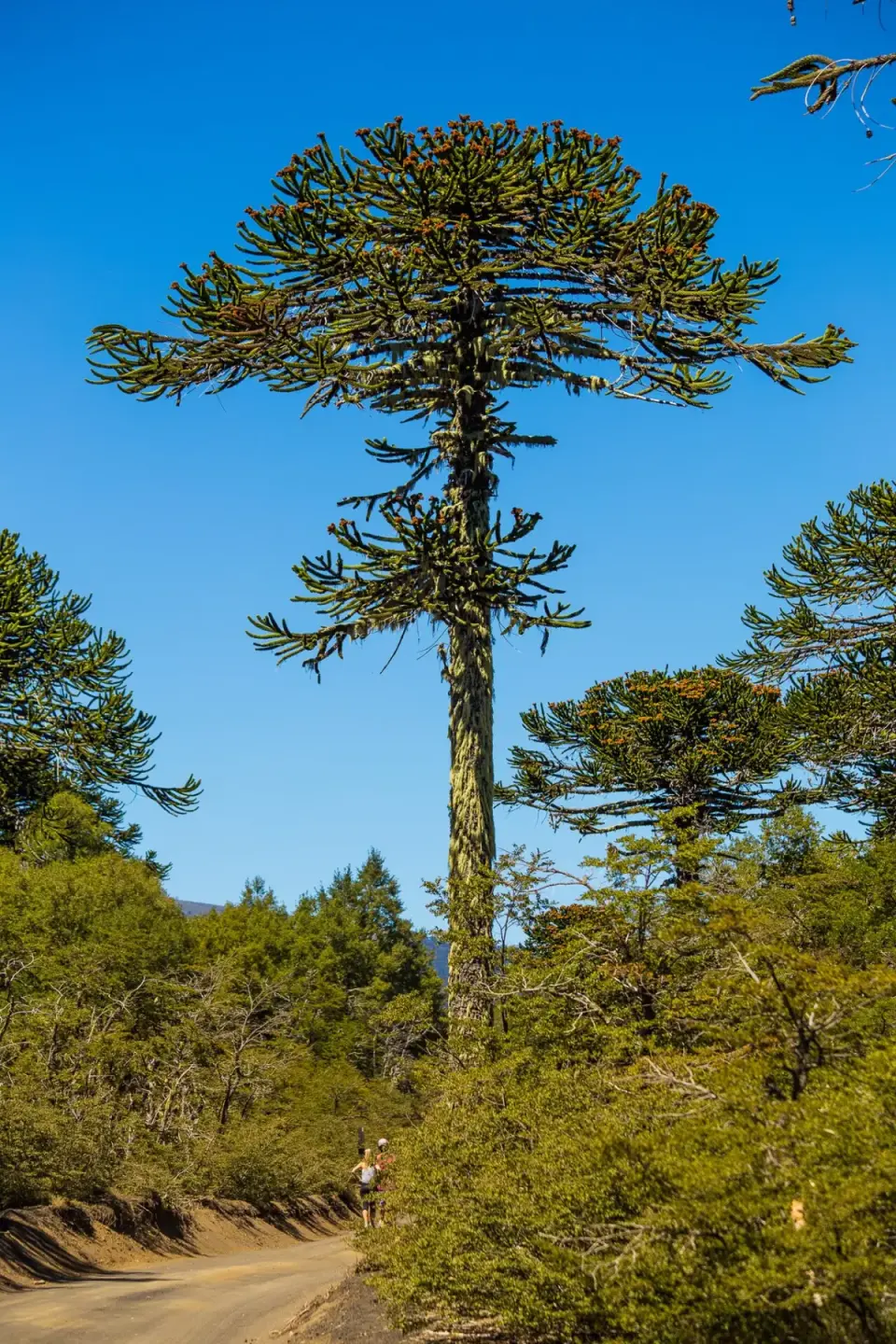
Chile · #2 tree Natural monument of Chile; sacred tree of the Pehuenche people
Monkey puzzle tree
Araucaria araucana · locally: pehuén (araucaria)
An ancient tree with branches like scaly snakes – sacred to the Pehuenche, the “people of the pehuén”, and a source of their food.
The monkey puzzle tree is a conifer reaching 40–50 m and living more than a thousand years. Its branches are covered with sharp, triangular, overlapping leaves, and old trees have an umbrella-shaped crown set high on a thick, fire-resistant trunk. It grows on the slopes of volcanoes and in the mountains, often on poor soils formed from volcanic ash. Its female cones, the size of a child’s head, contain hundreds of large, edible seeds – piñones. The ancestors of the araucaria grew in the age of the dinosaurs, which is why these trees are called living fossils.
Significance in the country
Since 1990 the monkey puzzle tree has been a natural monument in Chile and may not be felled; piñones are the basis of the traditional Pehuenche diet, and araucaria forests give their character to the Conguillío and Nahuelbuta national parks.
Where it grows
In the Andes of the Biobío and Araucanía regions (including around the Lonquimay and Llaima volcanoes) and on isolated peaks of the Coastal Range in Nahuelbuta.
More: Wikipedia (en) Wikipedia (pl)