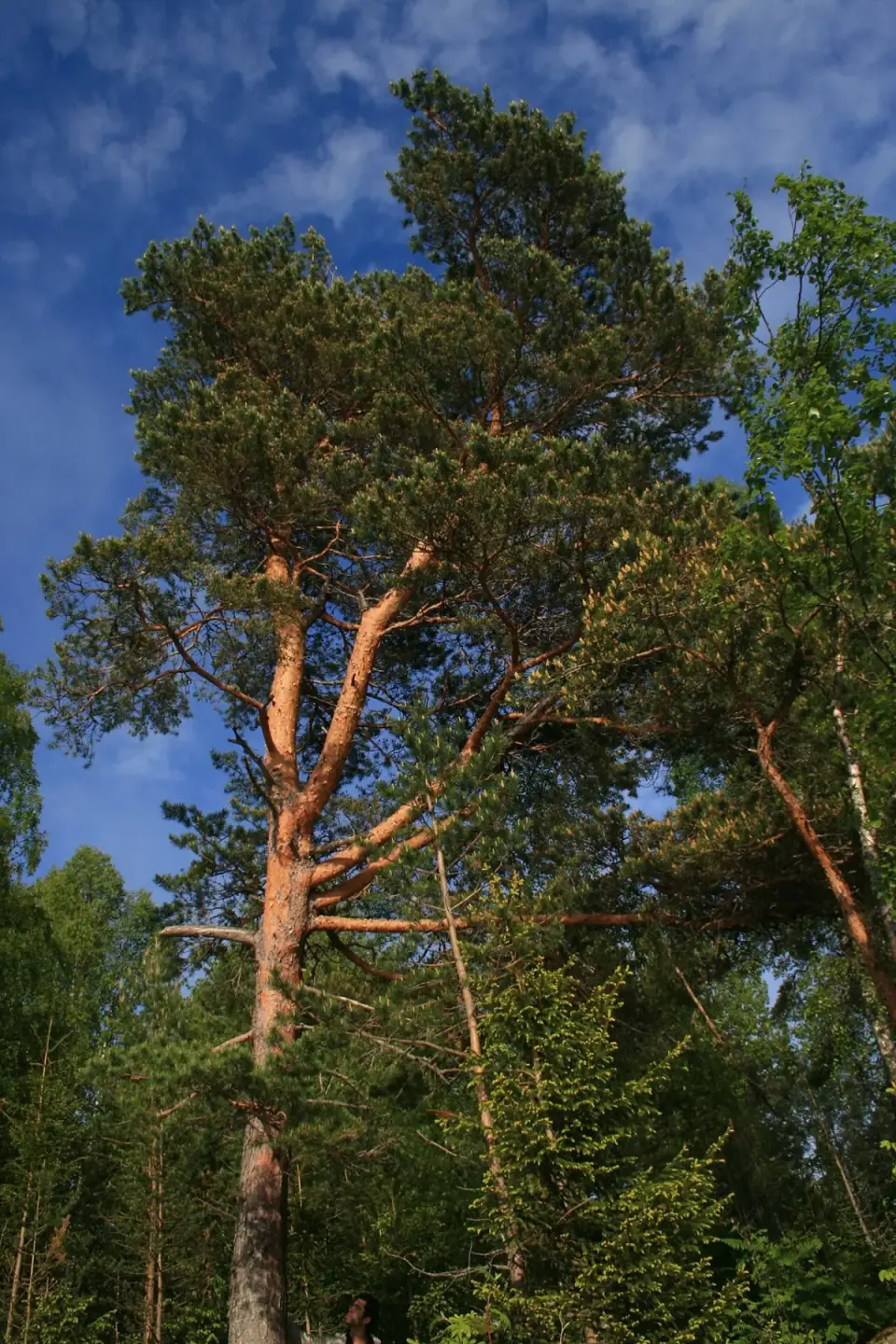
Scots pine (Pinus sylvestris)
Photo: Mickaël Delcey (Silverkey), CC BY-SA 3.0, Wikimedia Commons

On the map in 11 countries tree

Scots pine

Pinus sylvestris

Family: Pinaceae

On our map this plant appears in 11 countries and ranks highest in: Poland, Belarus, Finland, Lithuania, Estonia, Latvia and others.

The Scots pine is a conifer growing to 35–40 m, easily recognised by the orange-russet, flaking bark on the upper trunk and its paired, bluish-green needles. It is undemanding – it grows on poor sands, dunes and peat bogs, so as a pioneer it colonises waste ground. Its wood is the basic raw material for the sawmill, furniture and paper industries, and its resin was once used to make turpentine and rosin. On parched sands it forms bright pinewoods with heather and reindeer lichens, while on bogs it takes on dwarf forms.

Description from: Poland.

More: Wikipedia (en) Wikipedia (pl) Plants of the World Online (Kew)

Significance in each country

  1. Poland no. 3 of 15 native

    Poland is one of the European strongholds of the pine, which dominates about 58% of the country’s forest area. The pinewoods of the Notecka Forest, the Tuchola Forest and the Kampinos Forest are the most typical image of a Polish forest.

  2. Belarus no. 4 of 8 native

    Pine forest is the most typical landscape of Belarus and the backbone of its timber industry. The pinewoods also provide mushrooms and berries – foraging in the forest is almost a national sport in Belarus.

  3. Finland no. 4 of 10 native

    The pine is the most important tree of Finland’s forests and timber industry, and in the 18th–19th centuries Finland was one of the world’s largest exporters of pine tar.

  4. Lithuania no. 4 of 8 native

    The pine is the commonest tree in Lithuania’s forests. On the Curonian Spit, a UNESCO World Heritage Site, pines and dwarf mountain pines were planted in the 19th century to stop the dunes burying fishing villages, and in Dzūkija gathering…

  5. Estonia no. 6 of 8 native

    The pine is the most important tree in Estonian forestry, and pinewoods on coastal dunes and bogs are among the most typical Estonian landscapes – they can be admired, for example, in Lahemaa National Park.

  6. Latvia no. 6 of 8 native

    Pine covers about a third of Latvia’s forests and is the main tree of the timber industry, one of the country’s most important export sectors.

  7. Norway no. 6 of 10 native

    The heartwood of slow-growing pines – known as malmfuru – was used to build medieval stave churches such as Urnes and Borgund, which have stood for more than 800 years.

  8. Sweden no. 6 of 10 native

    In the 17th and 18th centuries, wood tar from pines was one of the most important exports of the Kingdom of Sweden, essential for waterproofing wooden ships.

  9. Kazakhstan no. 7 of 10 native

    In largely treeless Kazakhstan, pine forests are a rarity and a precious heritage – pine-clad granite mountains form the Burabay and Bayanaul national parks, and narrow belts of pinewood running along the Irtysh are protected by the Semey…

  10. Czechia no. 10 of 10 native

    Pine makes up well over a tenth of Czech forest stands and is the second most important commercial species after spruce.

  11. Russia no. 12 of 15 native

    The pine is one of Russia’s main forest-forming trees, and its bright pinewoods – from the forests around Moscow to the ribbon pine forests of Altai Krai – are a recurring motif in Russian painting and poetry.