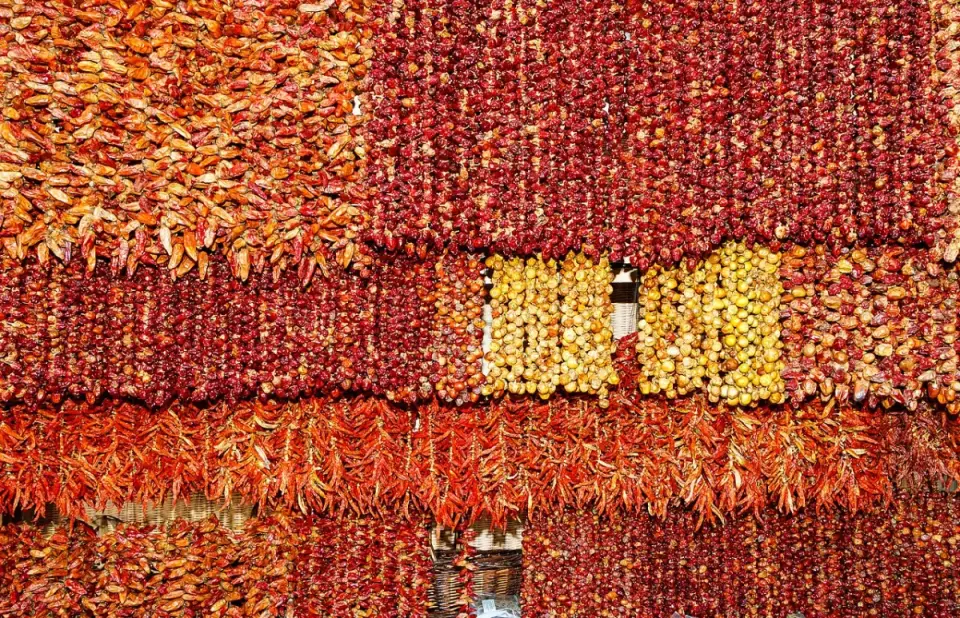
Chili pepper (Capsicum annuum)
Photo: H. Zell, CC BY-SA 3.0, Wikimedia Commons

On the map in 7 countries crop symbol: Hungary

Chili pepper

Capsicum annuum

Family: Solanaceae

On our map this plant appears in 7 countries and ranks highest in: Hungary, Bhutan, Serbia, Tunisia, Mexico, South Korea and others.

The chili pepper is a plant of the nightshade family growing to a metre tall, with white flowers and fruits – berries of astonishingly varied shape, colour and heat. The burning taste comes from capsaicin, concentrated mainly in the white membranes around the seeds. The species includes both mild sweet peppers and hot chillies, and in Mexico the same fruits change their name when dried: poblano becomes ancho, and smoked jalapeño becomes chipotle. The fruits are rich in vitamin C and carotenoids.

Description from: Mexico.

More: Wikipedia (en) Wikipedia (pl) Plants of the World Online (Kew)

Significance in each country

  1. Hungary no. 1 of 8 cultivated

    Hungarikum – a symbol of Hungarian cuisine

    Ground paprika from Szeged and Kalocsa has hungarikum status, and both Kalocsa and Szeged have paprika museums. It was in Szeged that Albert Szent-Györgyi isolated vitamin C from paprika, for which he received the Nobel Prize in 1937.

  2. Bhutan no. 4 of 5 cultivated

    Chili is the foundation of Bhutanese cuisine – it is eaten every day as a vegetable, and in autumn the roofs of houses turn red with drying chillies; the national dish, ema datshi, is chili stewed with local cheese.

  3. Serbia no. 6 of 8 cultivated

    Leskovac in southern Serbia is famous for its ajvar and hot peppers, while in Vojvodina, especially around Horgoš, peppers have long been grown for ground paprika (aleva paprika).

  4. Tunisia no. 6 of 8 cultivated

    Harissa – a paste of dried chillies, garlic, coriander, caraway and olive oil – goes into couscous, shakshuka, soups and sandwiches, and in 2022 the knowledge and practices involved in making it were inscribed on the UNESCO list.

  5. Mexico no. 7 of 15 native

    The pepper was domesticated in Mexico, and the word “chili” comes from Nahuatl. Chile is the basis of salsas, moles and countless dishes, and chiles en nogada from Puebla – in the colours of the Mexican flag – is one of the country’s most…

  6. South Korea no. 7 of 10 cultivated

    The chili pepper probably reached Korea around the turn of the 17th century, and within two centuries it had transformed Korean cooking – it is what made kimchi red and spicy.

  7. Bulgaria no. 8 of 8 cultivated

    Bulgarian market gardeners (gradinari) were famous throughout Central Europe in the 19th and 20th centuries for growing vegetables, and peppers remain their pride to this day.