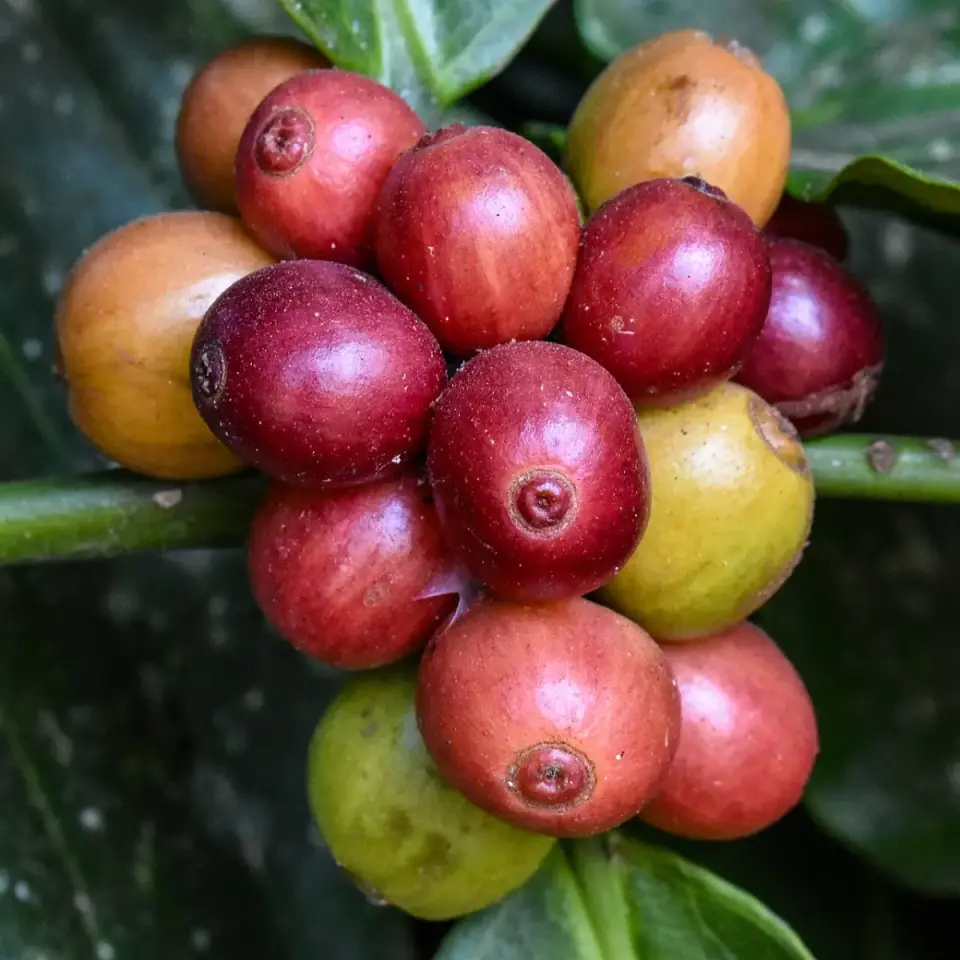
Robusta coffee (Coffea canephora)
Photo: This Photo was taken by Timothy A. Gonsalves. Feel free to use my photos, but please mention me as the author. I would much appreciate if you send me an email tagooty@yahoo.com or write on my talk pa…, CC BY-SA 4.0, Wikimedia Commons

On the map in 6 countries crop symbol: Angola

Robusta coffee

Coffea canephora

Family: Rubiaceae

On our map this plant appears in 6 countries and ranks highest in: Uganda, Vietnam, Angola, Côte d’Ivoire, Togo, DR Congo.

A shrub or small tree growing to 10 m, native to the forests of West and Central Africa. Compared with arabica it is more resistant to disease and heat and gives heavier yields, and its beans contain almost twice as much caffeine. It produces a strong, bitter, full-bodied coffee used in espresso blends and instant coffee. It bursts into white flower after the rains, and its fruits ripen to a deep red.

Description from: Uganda.

More: Wikipedia (en) Wikipedia (pl) Plants of the World Online (Kew)

Significance in each country

  1. Uganda no. 1 of 5 native

    Uganda is one of the centres of origin of robusta – wild populations grow in the Kibale and Mabira forests – and Africa’s second-largest coffee producer after Ethiopia; coffee is the country’s most important export, grown by more than a…

  2. Vietnam no. 2 of 10

    Coffee was brought to Vietnam by the French in the 19th century, and after the reforms of the 1980s the country became a coffee giant – the city of Buôn Ma Thuột is known as the coffee capital.

  3. Angola no. 3 of 10 native

    Coffee leaves on the national emblem of Angola

    Robusta plantations in Uíge, Cuanza Norte and on the slopes of Amboim made colonial Angola a coffee powerhouse; the civil war almost destroyed them, but coffee remains on the national emblem alongside maize and cotton, and the state is…

  4. Côte d’Ivoire no. 3 of 8 native

    The slogan “café-cacao” sums up the economic history of independent Côte d’Ivoire: for decades coffee, alongside cocoa, was the country’s main source of income.

  5. Togo no. 4 of 5 native

    Coffee and cocoa are traditionally the main export crops of south-western Togo, and the landscape around Kpalimé is made up of shaded coffee plantations interspersed with forest.

  6. DR Congo no. 6 of 10 native

    Wild forms of robusta grow in the forests of the Congo Basin, and in colonial times and under Mobutu coffee was one of the country’s more important exports.