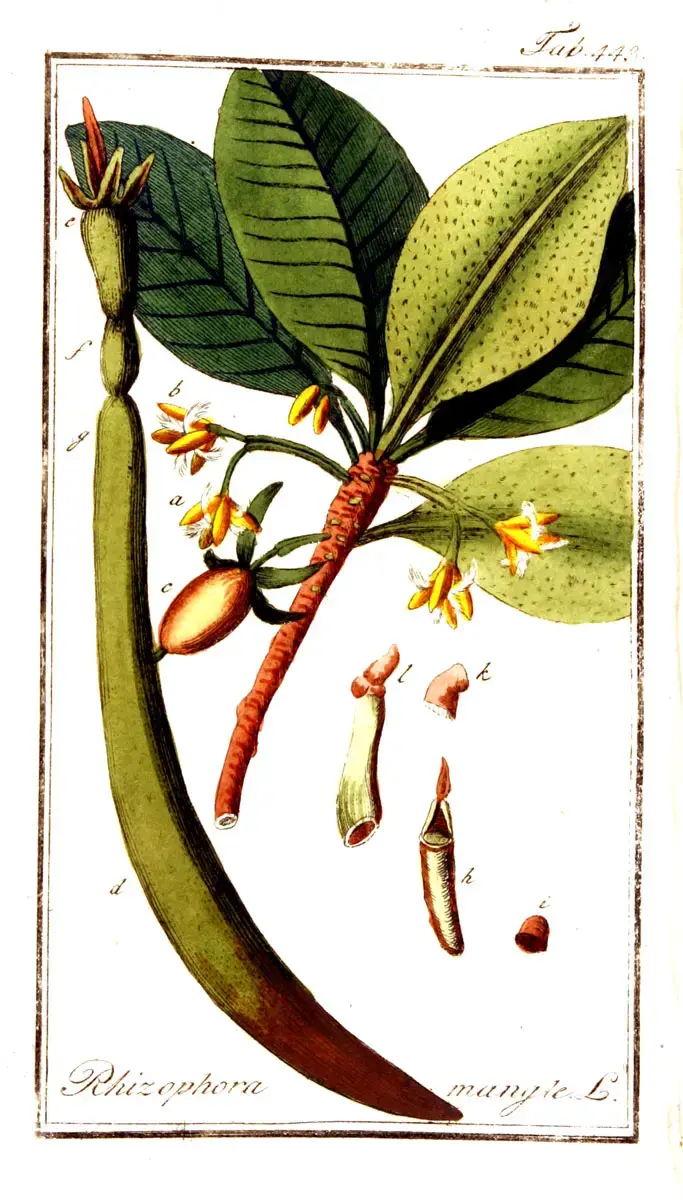
Red mangrove (Rhizophora mangle)
Photo: Johannes Zorn (1739-1799), Public domain, Wikimedia Commons

On the map in 4 countries tree

Red mangrove

Rhizophora mangle

Family: Rhizophoraceae

On our map this plant appears in 4 countries and ranks highest in: Guinea-Bissau, Antigua & Barbuda, Bahamas, Belize.

The red mangrove, Rhizophora mangle, is a tree of the tidal zone that stands on a tangle of arching prop roots, allowing it to grow in salty mud flooded twice a day. Its leaves are leathery and glossy, and its seeds germinate while still on the tree – the long seedlings drop into the mud or float away on the water. Mangroves trap sediment and protect the coast from waves, and fish, crabs and oysters breed among their roots.

Description from: Guinea-Bissau.

More: Wikipedia (en) Wikipedia (pl) Plants of the World Online (Kew)

Significance in each country

  1. Guinea-Bissau no. 3 of 5 native

    The tarrafe form the most characteristic landscape of Guinea-Bissau’s coast and are protected, among other places, in the Cacheu River Mangroves Natural Park and the Bijagós Biosphere Reserve.

  2. Antigua & Barbuda no. 4 of 5 native

    On Barbuda, the mangroves around Codrington Lagoon form a reserve where several thousand magnificent frigatebirds nest; on Antigua, mangrove-lined bays give yachts a natural refuge from hurricanes.

  3. Bahamas no. 4 of 5 native

    Mangroves cover huge areas of the Bahamas, especially along the west coast of Andros; they underpin fishing and angling tourism, and after hurricanes they prove to be the best natural coastal defence.

  4. Belize no. 5 of 5 native

    Mangroves fringe the coast and almost all of Belize’s islets and are vital to the health of the barrier reef, a UNESCO World Heritage Site.