Namibia · #6 perennial
Devil’s claw
Harpagophytum procumbens · locally: duiwelsklou
Namibia is the world’s largest exporter of devil’s claw – medicinal root tubers gathered on the sands of the Kalahari.
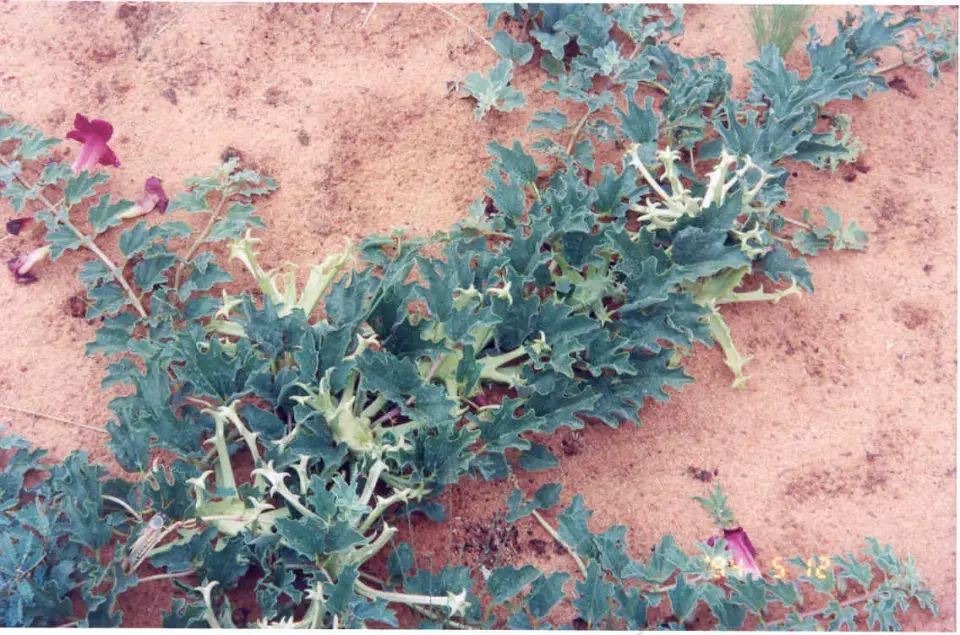
Devil’s claw is a trailing perennial of the sesame family whose stems spread 1–2 m across the sandy ground after the rainy season. It has lobed leaves and large, funnel-shaped flowers in shades of pink and purple with a yellowish throat. Its fruits are covered in long, curved hooks that catch in the fur and hooves of animals – hence the plant’s name. Underground it forms tuberous storage roots containing harpagoside, used in herbal medicine for joint pain and digestive complaints.
Significance in the country
The tubers are gathered mainly by the San and other rural people of eastern and central Namibia, for whom it is one of the few sources of income. To avoid wiping out the populations, harvesting permits have been introduced, along with a rule that the main root, from which the plant regrows, must be left in the ground.
Where it grows
Grows on the sandy soils of the Kalahari in eastern and central Namibia – most abundant in the Omaheke, Otjozondjupa and Kavango regions, and also in Khomas, Hardap and ǁKaras.
More: Wikipedia (en)