Japan · #5 tree Emblem of the Government of Japan (go-shichi no kiri paulownia)
Princess tree
Paulownia tomentosa · locally: kiri (桐)
Paulownia leaves and flowers form the emblem of the Japanese government – it appears on the 500-yen coin, among other places.
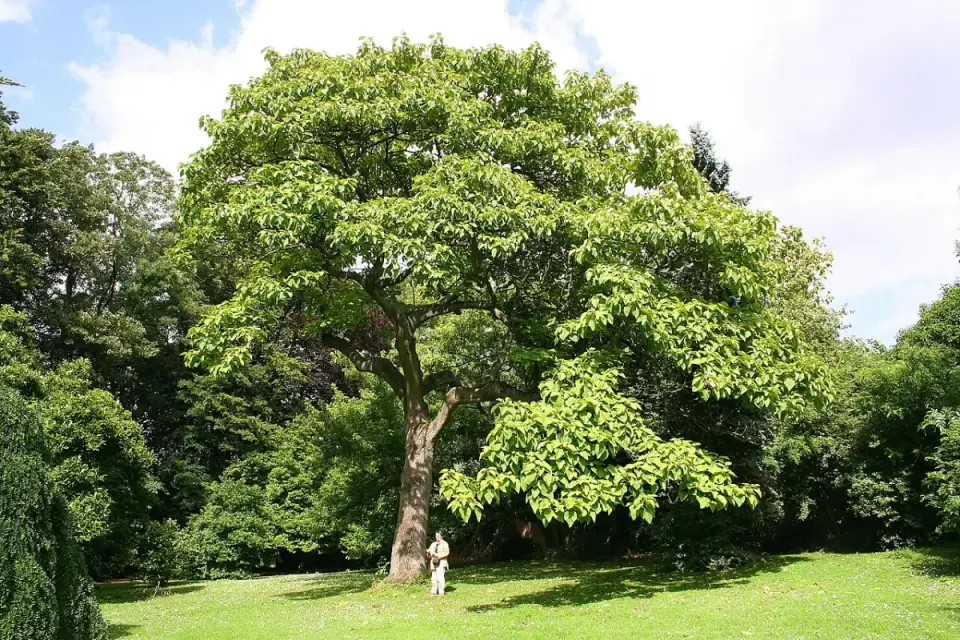
A fast-growing tree reaching 15–20 m, with huge, heart-shaped, velvety leaves. In spring, before the leaves unfold, it is covered in upright panicles of purple, bell-shaped, fragrant flowers, and in autumn it produces woody capsules holding thousands of tiny winged seeds. It comes from China but has been grown in Japan for more than a thousand years. Its wood is very light yet resistant to damp and hard to ignite, so it is used for chests, tansu cabinets, geta sandals and musical instruments such as the koto zither.
Significance in the country
The kiri motif with three flower clusters of 5, 7 and 5 blossoms (go-shichi no kiri) is the emblem of the government and the Prime Minister’s Office of Japan; traditionally a paulownia was planted when a daughter was born, so that its wood could be made into a chest for her dowry.
Where it grows
Cultivated and naturalised on Honshu, Shikoku and Kyushu; traditional centres of kiri wood include Aizu in Fukushima Prefecture and Iwate, and of tansu chests Kamo in Niigata Prefecture.
More: Wikipedia (en) Wikipedia (pl)