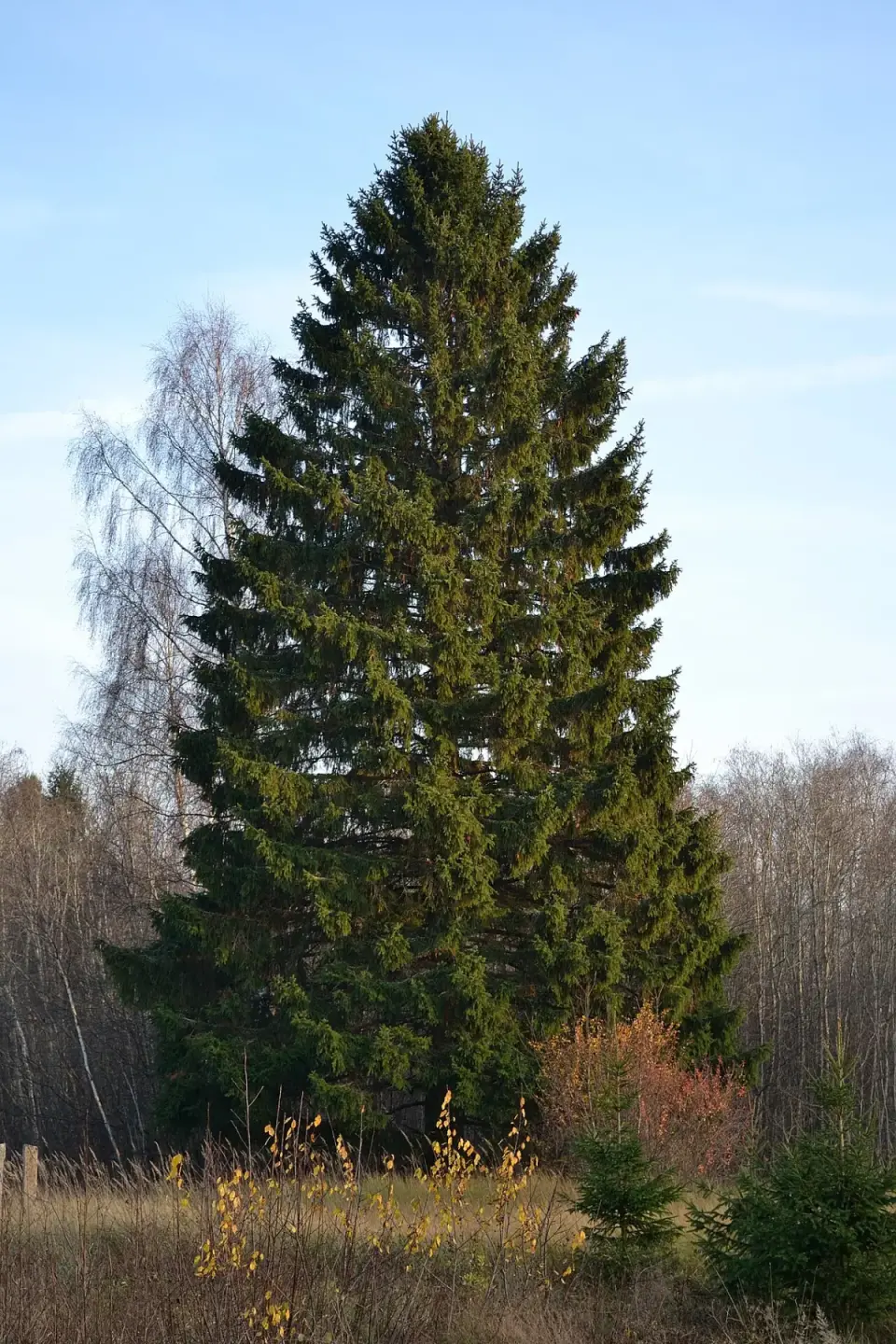
Austria · #7 tree
Norway spruce
Picea abies · locally: Fichte
Spruce is the key tree of Austria’s forests, which cover almost half the country – its wood builds Alpine houses and musical instruments.
The Norway spruce is a tall conifer reaching up to 50 m, with a narrow, conical crown, often drooping branches and short, prickly, four-sided needles. Its long, hanging cones fall whole once they have shed their seeds. Its shallow root system makes it prone to being uprooted in gales, and trees weakened by drought are attacked by the European spruce bark beetle. Its light, springy wood is a staple raw material for sawmills and paper mills, and the finest slow-grown mountain spruces yield tonewood for instrument soundboards.
Significance in the country
Forests cover nearly half of Austria, and spruce accounts for about half of their area, underpinning a strong timber industry. Alpine spruce was used to build wooden houses, shingles and granaries, and Austrian luthiers and piano makers prize tonewood from slow-growing mountain trees.
Where it grows
Dominant in the forests of the Alps – in Tyrol, Salzburg, Carinthia, Styria and Vorarlberg – and in the Waldviertel and Mühlviertel in the north; scarcest in the dry lowlands of Burgenland and around Vienna.
More: Wikipedia (en) Wikipedia (pl)