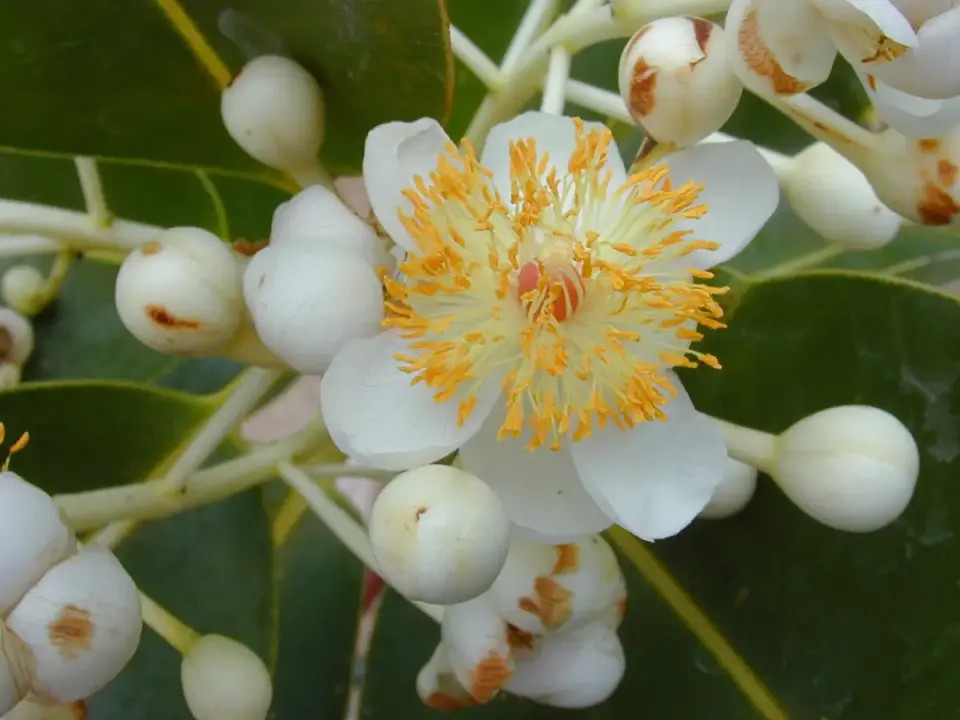
Tamanu (Calophyllum inophyllum)
Photo: Forest & Kim Starr, CC BY 3.0, Wikimedia Commons

On the map in 4 countries tree symbol: Nauru

Tamanu

Calophyllum inophyllum

Family: Calophyllaceae

On our map this plant appears in 4 countries and ranks highest in: Nauru, Maldives, French Polynesia, Seychelles.

Tamanu, known on Nauru as tomano, is a spreading tree growing to 20 m, with thick, glossy leaves marked by dense, parallel veins. It bears fragrant white flowers with numerous yellow stamens and round green fruits with a large seed, which is pressed for a medicinal oil. It tolerates salt, wind and drought superbly, so it grows on the coasts of tropical islands from East Africa to Polynesia. Its hard, durable wood was used to build canoes and houses.

Description from: Nauru.

More: Wikipedia (en) Plants of the World Online (Kew)

Significance in each country

  1. Nauru no. 1 of 5 native

    Sprig of tomano flowers on the coat of arms of Nauru

    Nauru’s coat of arms, designed in 1968, the year the country gained independence, features a sprig with seven tomano flowers.

  2. Maldives no. 3 of 5 native

    Funa was the most valuable timber for Maldivians – it was used to build the hulls of dhoni boats and the beams of old mosques, and the spreading trees give shade on the beaches of many islands.

  3. French Polynesia no. 4 of 5 cultivated

    In old Polynesia tamanu was planted beside marae – stone places of worship – and regarded as a sacred tree, and its wood was carved into bowls and canoes. Tamanu oil is today one of the best-known traditional products of French Polynesia.

  4. Seychelles no. 4 of 5 native

    The takamaka is the classic tree of Seychelles beaches – it provides shade at Anse Lazio and Beau Vallon, and the Takamaka district in the south of Mahé is named after it. Its wood was traditionally used by boatbuilders to make pirogues.