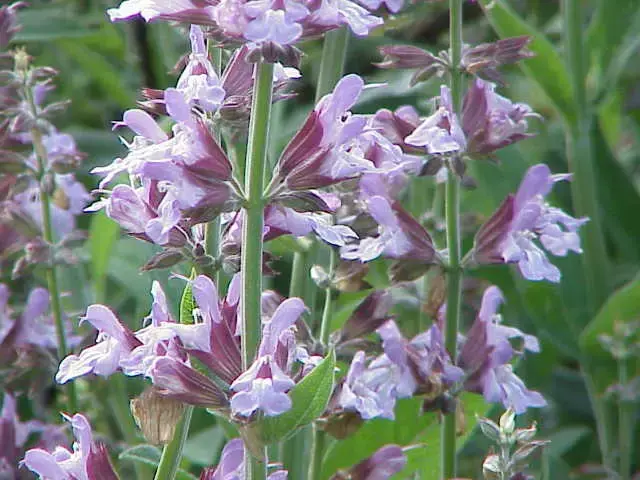
Sage (Salvia officinalis)
Photo: Kurt Stüber [1], CC BY-SA 3.0, Wikimedia Commons

On the map in 3 countries dwarf shrub

Sage

Salvia officinalis

Family: Lamiaceae

On our map this plant appears in 3 countries and ranks highest in: Albania, Bosnia & Herzegovina, Croatia.

A subshrub 30–70 cm tall, with stems that are woody at the base and oblong, grey-green, wrinkled leaves that are densely hairy and strongly aromatic. In early summer it bears blue-violet, two-lipped flowers that are popular with bees. It grows naturally on dry, sunny, stony slopes in the western Balkans. The leaves contain an essential oil with antiseptic and anti-inflammatory properties – they are used as a gargle for sore throats and as a seasoning for meat.

Description from: Albania.

More: Wikipedia (en) Wikipedia (pl) Plants of the World Online (Kew)

Significance in each country

  1. Albania no. 2 of 5 native

    Gathering wild herbs is an important source of income for thousands of Albanian families, and sage is the most important of them all – for decades the country has supplied it to the food and pharmaceutical industries of Europe and America.

  2. Bosnia & Herzegovina no. 3 of 5 native

    Herzegovina is one of the places where sage grows wild over large areas; gathering and drying kadulja, as it is called locally, and producing sage honey are a traditional source of income for rural families.

  3. Croatia no. 8 of 8 native

    Sage growing wild on the karst islands and coast was for centuries an important Dalmatian export, and “Dalmatian sage” became a byword in the trade for the highest quality.