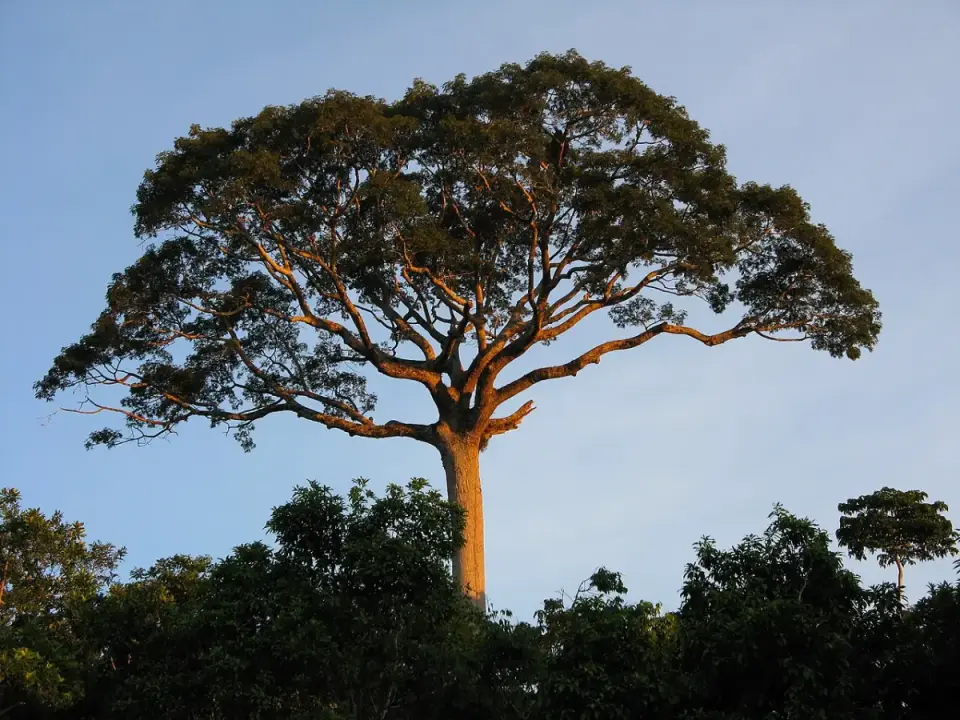
Kapok tree (Ceiba pentandra)
Photo: Klaus Schönitzer, CC BY-SA 3.0, Wikimedia Commons

On the map in 9 countries tree symbol: Equatorial Guinea, Guatemala, Guinea-Bissau, Haiti, Puerto Rico, Sierra Leone

Kapok tree

Ceiba pentandra

Family: Malvaceae

On our map this plant appears in 9 countries and ranks highest in: Equatorial Guinea, Sierra Leone, Côte d’Ivoire, Guatemala, Guinea-Bissau, Puerto Rico and others.

One of the tallest trees in the tropics, growing to 50–70 m, with a straight, columnar trunk with tall buttress roots and a broad, umbrella-shaped crown. In the dry season it sheds its leaves and flowers, then produces fruits filled with silky fluff – kapok, once used to stuff mattresses and life jackets. The flowers are pollinated by bats. It grows in lowland forests and in pastures, where it is often left standing as a shade tree.

Description from: Guatemala.

More: Wikipedia (en) Wikipedia (pl) Plants of the World Online (Kew)

Significance in each country

  1. Equatorial Guinea no. 1 of 5 introduced or naturalised

    The tree on the coat of arms of Equatorial Guinea (also shown on the flag)

    The ceiba appears on the coat of arms of Equatorial Guinea and in the centre of its flag; known as the “God tree”, it is said by tradition to have witnessed the agreement between local rulers and the Spanish, and it symbolises national…

  2. Sierra Leone no. 1 of 5 introduced or naturalised

    The famous Cotton Tree – historic symbol of Freetown and Sierra Leone

    According to tradition, freed Black settlers from Nova Scotia prayed under the Cotton Tree in Freetown in 1792 as they founded the city.

  3. Côte d’Ivoire no. 2 of 8 cultivated

    In Côte d’Ivoire the fromager is a sacred tree – many peoples believe it is inhabited by spirits, and offerings are made at its trunk.

  4. Guatemala no. 2 of 8 native

    National tree of Guatemala (since 1955)

    In Maya cosmology the ceiba (yaxche) was the world tree, its roots reaching down to the underworld of Xibalbá and its crown up to the heavens.

  5. Guinea-Bissau no. 2 of 5 introduced or naturalised

    Sacred tree of many peoples of Guinea-Bissau

    In Guinea-Bissau the poilão is a sacred tree: according to the beliefs of the Bijagó, Papel and Balanta peoples, ancestral spirits and guardian irãs dwell in it, and rituals are held beneath its crown.

  6. Puerto Rico no. 2 of 5 native

    National tree of Puerto Rico

    For the Indigenous Taíno the ceiba linked the world of the living with the afterlife, and famous old specimens – such as the centuries-old ceiba in Ponce or the giant on the island of Vieques – are now protected as natural and historic…

  7. Suriname no. 2 of 5 native

    In the Winti religion, practised by the descendants of enslaved Africans, the kankantrie is the abode of spirits and deities, so old kapok trees are revered and protected from felling.

  8. Haiti no. 3 of 5 native

    Sacred tree in Haitian Vodou

    In Haitian Vodou the mapou is regarded as a dwelling place of the lwa spirits and a passage between the world of the living and the dead; offerings are left at old trees, and many of them have been spared from felling as a result.

  9. Cuba no. 6 of 10 native

    In Afro-Cuban religions the ceiba is the dwelling place of the orishas and ancestral spirits; offerings are left at its foot, and many Cubans would never cut one down.