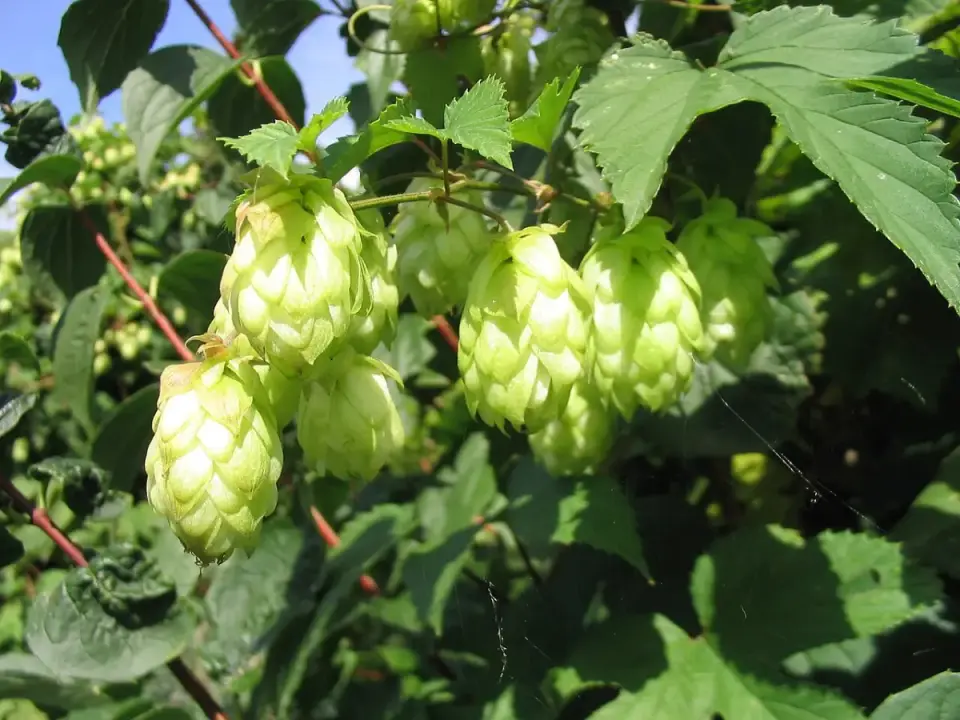
Hop (Humulus lupulus)
Photo: No machine-readable author provided. Hagen Graebner assumed (based on copyright claims)., CC BY-SA 2.5, Wikimedia Commons

On the map in 4 countries crop

Hop

Humulus lupulus

Family: Cannabaceae

On our map this plant appears in 4 countries and ranks highest in: Czechia, Slovenia, Germany, Belgium.

A perennial climber of the hemp family whose shoots twine clockwise and can climb 7–8 m in a single season. Male and female flowers grow on separate plants – only female plants are grown, because their inflorescences, called cones, contain yellow glands of lupulin. The bitter acids and essential oils it contains give beer its bitterness and aroma and also act as a preservative. In the wild, hops grow in damp thickets and riparian forests.

Description from: Czechia.

More: Wikipedia (en) Wikipedia (pl) Plants of the World Online (Kew)

Significance in each country

  1. Czechia no. 2 of 10 native

    Czechia is one of the world’s largest hop producers, and “Žatecký chmel” (Saaz hops) is an EU-protected geographical indication. It was the Žatec variety that gave its character to the first pilsner, brewed in Plzeň in 1842.

  2. Slovenia no. 4 of 5 native

    Hops have been grown around Žalec since the mid-19th century; Slovenian varieties such as Savinjski Golding (Styrian Golding), Celeia and Aurora are prized by breweries around the world, and Žalec is home to the Ecomuseum of Hop Growing…

  3. Germany no. 5 of 10 native

    Germany and the USA are the world’s largest hop producers, and the Bavarian Purity Law of 1516 names hops as one of only three permitted ingredients of beer, alongside barley and water.

  4. Belgium no. 7 of 8 native

    The area around Poperinge in West Flanders supplies most of Belgium’s hops; the town has a hop museum and every three years holds a hop festival with a grand parade.