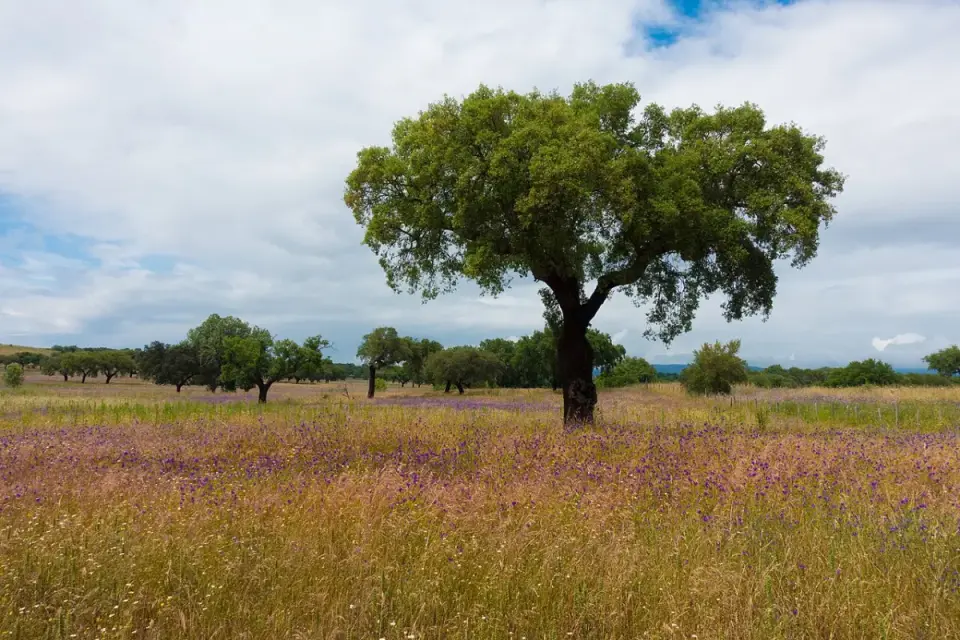
Cork oak (Quercus suber)
Photo: Kent Wang from London, United Kingdom, CC BY-SA 2.0, Wikimedia Commons

On the map in 4 countries tree symbol: Portugal

Cork oak

Quercus suber

Family: Fagaceae

On our map this plant appears in 4 countries and ranks highest in: Portugal, Algeria, Spain, Tunisia.

The cork oak is an evergreen oak with a broad crown and an exceptionally thick, spongy bark that protects it from fire and drought. The bark is first stripped by hand when the tree is about 25 years old and then every nine years; the tree regrows it and can live for 200–250 years. Cork is made into wine stoppers, insulation, flooring and handicrafts. Cork oak montados are a refuge for rare birds, including the Spanish imperial eagle.

Description from: Portugal.

More: Wikipedia (en) Wikipedia (pl) Plants of the World Online (Kew)

Significance in each country

  1. Portugal no. 1 of 10 native

    National tree of Portugal

    Portugal is the world leader in cork production, and in 2011 parliament declared the cork oak the national tree. Felling it has been restricted by law for centuries.

  2. Algeria no. 3 of 10 native

    After Portugal and Spain, Algeria has the third-largest area of cork oak forest in the world, and cork harvesting is a traditional occupation in Kabylia and around El Kala. Summer wildfires are increasingly destroying these forests.

  3. Spain no. 7 of 10 native

    Spain is the world’s second-largest cork producer after Portugal, and the harvest – “la saca” – takes place in summer, by hand, using axes.

  4. Tunisia no. 7 of 8 native

    Cork oak covers the mountains of Kroumirie and Mogod, the rainiest in the country, and the cork harvest provides work for many mountain villages.