Spain · #9 crop
Almond
Prunus amygdalus · locally: almendro
Spain has the world’s largest area of almond orchards, and almonds go into turrón – an essential Spanish Christmas treat.
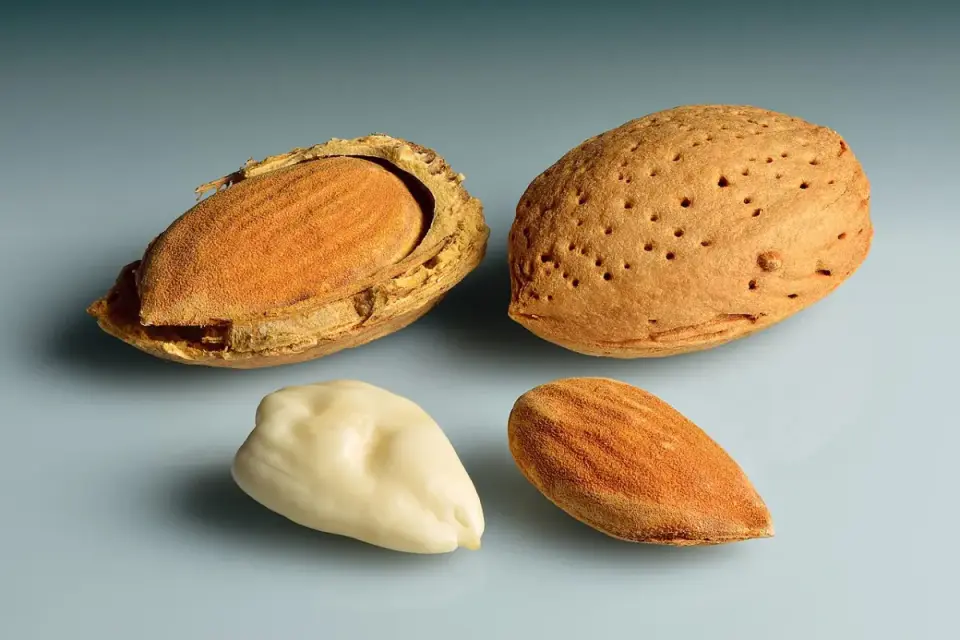
A small tree of the rose family, closely related to the peach, with lance-shaped, finely serrated leaves. It flowers very early, often as soon as January and February, before the leaves unfold – the branches are then covered in white or pinkish blossom. The fruit is a drupe with a green, felty husk that splits when ripe to reveal a woody stone containing the edible seed – the almond. The tree copes well with drought and poor, stony soils, so for centuries it has been planted on dry slopes and terraces.
Significance in the country
Spain is the second-largest almond producer after the United States, and the native marcona variety is considered one of the finest. Almonds are the basis of turrón from Jijona and Alicante and marzipan from Toledo, and the winter blossoming of the orchards in Andalusia, Murcia, Majorca and Gran Canaria draws tourists.
Where it grows
Most orchards are in Andalusia, Castilla–La Mancha, Aragon, Murcia and Valencia; there are also traditional plantings in Catalonia, the Balearic Islands (especially Majorca) and Gran Canaria.
More: Wikipedia (en) Wikipedia (pl)