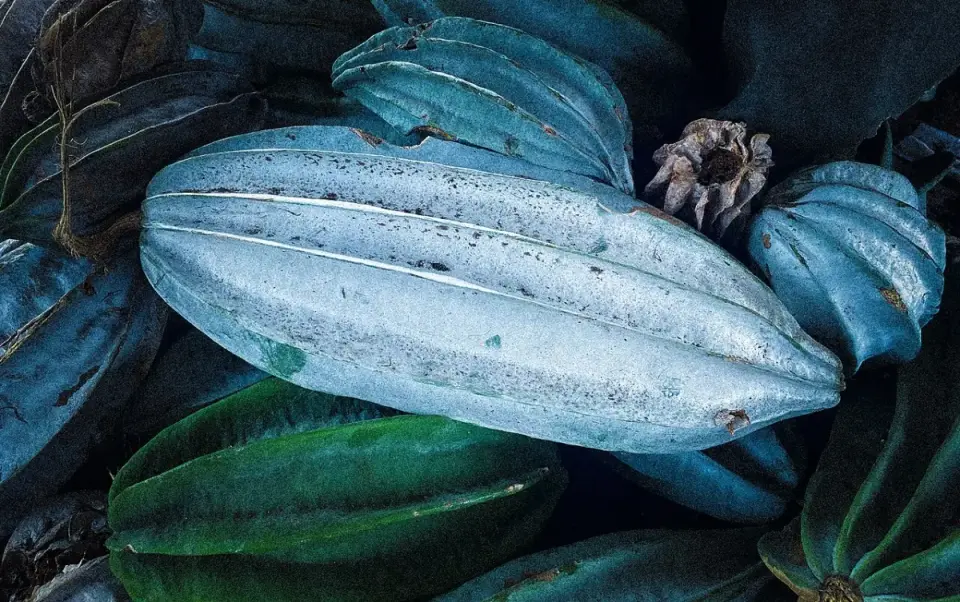
Nigeria · #9 climber
Fluted pumpkin
Telfairia occidentalis · locally: ugu (igbo), ikong-ubong (efik)
The leaves of ugu, also called fluted pumpkin, are the most important leaf vegetable of south-eastern Nigeria and an ingredient of edikang ikong soup.
Telfairia occidentalis is a perennial, dioecious climber of the gourd family that climbs supports with its tendrils or sprawls along the ground. It has compound, dark green leaves and white or cream flowers with a purple centre. The fruit is very large, elongated, deeply ribbed and green, can weigh several kilograms or even more than ten, and contains numerous flat, oily seeds. Both the young shoots and leaves, rich in iron and protein, and the seeds, which are boiled or ground, are edible.
Significance in the country
Ugu is grown on almost every farm in the south-east of the country, and its leaves go into the edikang ikong soup of the Efik and Ibibio peoples, egusi soups and ofe owerri. The species originates in the forests of this part of West Africa and has long been cultivated, especially by the Igbo.
Where it grows
Grown mainly in the south-east and the Niger Delta – in Imo, Anambra, Abia, Enugu, Ebonyi, Cross River, Akwa Ibom and Rivers states – and increasingly in the south-west of the country too.
More: Wikipedia (en)