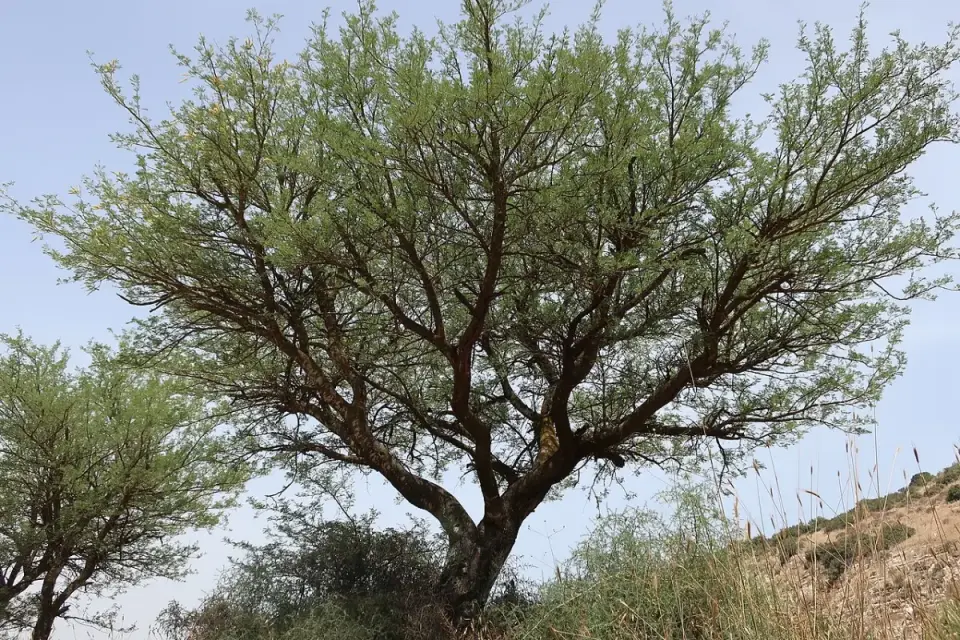
Niger · #1 tree
Apple-ring acacia
Faidherbia albida · locally: gao (zarma), gawo (hausa)
Thanks to farmers who began protecting gao shoots in their fields, trees have returned to about 5 million hectares of southern Niger.
A large tree with pale grey bark, white thorns and small, bluish-green leaflets, often reaching 20 m in height. Unusually, it loses its leaves in the rainy season and turns green in the dry season, so it does not compete with crops for light. Its fallen leaves and pods enrich the soil, and its roots fix nitrogen from the air. Under the crowns of gao trees, millet and sorghum yields are markedly higher than in open fields, and the orange, twisted pods are valuable fodder in the dry season.
Significance in the country
In the Maradi and Zinder regions, since the 1980s farmers have protected trees regrowing from stumps on a massive scale instead of cutting them down – thanks to this method, known as farmer-managed natural regeneration, Niger has gained about 200 million trees. Gao is one of the most important species of this green landscape.
Where it grows
On farmland throughout the agricultural south – from Tillabéri and Dosso to Maradi and Zinder; the densest tree cover is in the Maradi and Zinder regions.
More: Wikipedia (en) Wikipedia (pl)