France · #8 tree
Silver wattle
Acacia dealbata · locally: mimosa des fleuristes
In winter the hills of the Côte d’Azur turn gold with flowering mimosa, and the “Route du Mimosa” runs from Bormes-les-Mimosas to Grasse.
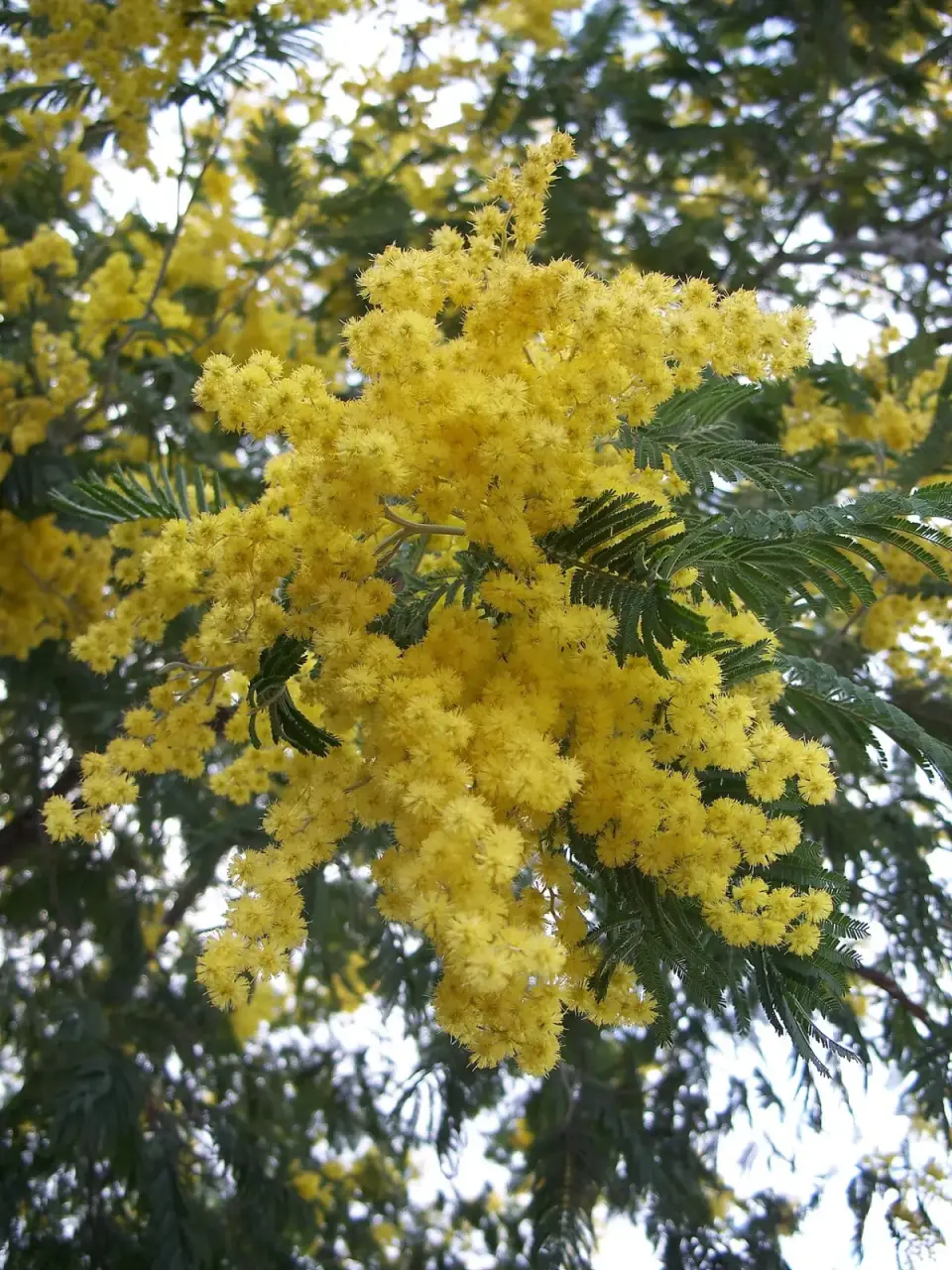
The silver wattle is a fast-growing evergreen tree of the legume family, native to south-eastern Australia and Tasmania, usually reaching 10–15 m. It has delicate, twice-pinnate leaves with a silvery-grey bloom and smooth, greenish-grey bark. From January to March it is smothered in thousands of round, fluffy, bright yellow flower heads with a honeyed scent. It readily resprouts from the roots and seeds itself freely, so in many Mediterranean countries it is considered an invasive species.
Significance in the country
Mimosa was brought to the Riviera in the 19th century as an ornamental for the gardens of aristocrats who wintered there, and it soon ran wild on the siliceous hills of the Tanneron and Esterel massifs. Mandelieu-la-Napoule holds a famous Mimosa Festival every year, and the flowers yield an absolute prized by the perfumers of Grasse.
Where it grows
Grows on the Côte d’Azur – in the Alpes-Maritimes and the Var, most abundantly in the Tanneron and Esterel massifs and around Bormes-les-Mimosas – and in Corsica.
More: Wikipedia (en) Wikipedia (pl)